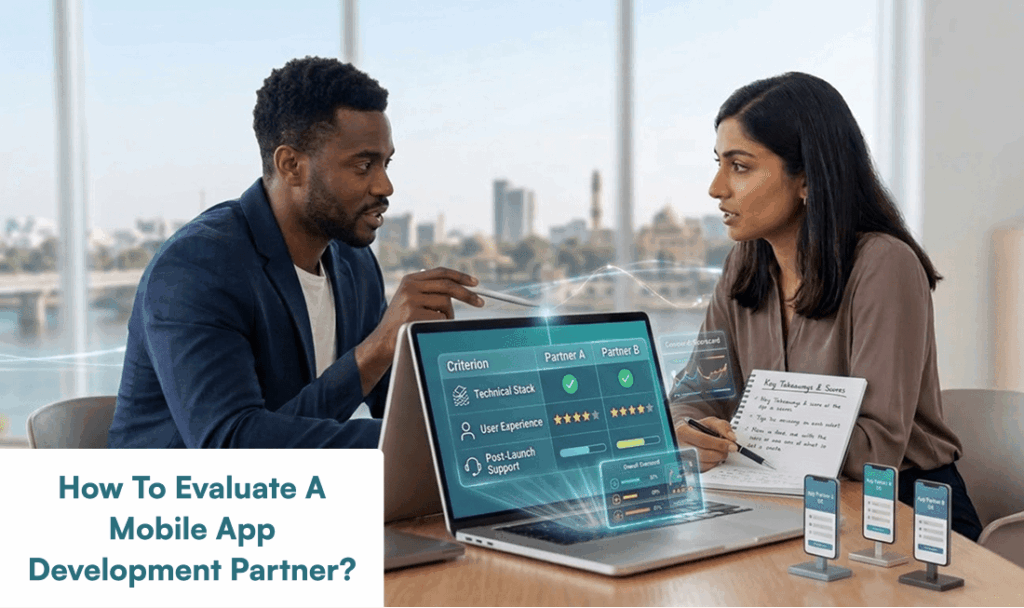

Quick Answer: The biggest mistake founders make is treating a development agency as a vendor. The right mobile development partner asks hard questions, runs a discovery phase, and stays engaged post-launch, not just through the build.
The global mobile app development market is projected to hit USD 553 billion by 2033.
With that much at stake, choosing the wrong development partner is one of the most expensive decisions a startup founder or product leader can make.
Not just expensive in money but in time, momentum, and product quality.
I’ve personally seen:
- Startups lose 6 months of runway to a full rebuild after a bad partner engagement
- Apps ship with a poor UX that drove early users away permanently
- Technical decisions made in the first month can create long-term challenges for teams even years later.
I’ve been on both sides. Early in my career, I was part of teams being evaluated. Now, as a founder running a software company, I see exactly what separates a genuine development partner from a project vendor.
1. Start With a Mindset Shift: Partner, Not Vendor
Partner vs. Vendor: The Mindset Shift That Changes Everything
Most founders say they want a “partner.” But most agencies operate like vendors.
Here’s the difference:
| Vendor | Partner |
| Follows your specs exactly | Challenges weak assumptions |
| Agrees with your timeline | Questions about unrealistic deadlines |
| Builds what you ask | Improves what you need |
| Disappears after handoff | Stays engaged post-launch |
The key signal? A real partner will push back even in the sales conversation.
If an agency agrees with everything you say before signing, be cautious. That compliance will not serve you when the hard decisions need to be made mid-project.
2. What to Look For: The Signals That Actually Matter
Before evaluating anyone on price or portfolio, focus on these high-impact signals.
1. The Quality of Their Discovery Questions
Strong teams ask about your users, architecture, integrations, and growth plans before they ever quote a price.
Watch out for teams that open with: What’s your budget and timeline?
Good teams open with:
- Who are your target users and what behaviour are you solving for?
- What are your performance and scalability requirements?
- What third-party integrations and APIs are involved?
- What does your existing technical environment look like?
The questions reveal whether they’re thinking about your product or just scoping a contract.
2. How They Handle Uncertainty
Every mobile project hits ambiguity. Requirements evolve. Integrations surprise you.
Ask: “How do you manage unclear or changing specifications mid-project?”
Experienced teams have a structured answer. Vague promises of we’re flexible with everything are a warning sign, not a green flag.
3. Honest Case Studies and Client References
Agency websites feature curated success stories.
Ask for something different: references from projects that faced delays or went off-plan. How did they respond? Did they communicate problems early or hide them?
That’s the reference conversation that tells you what working with them is actually like.
4. Platform-Specific Technical Depth
Mobile development requires real expertise; iOS, Android, Flutter, and React Native are not interchangeable skill sets.
Ask for a technical opinion on a platform decision relevant to your project. A team that says we follow best practices without substance has told you everything.
If possible, ask to review sample code and inquire specifically about:
- Unit testing and UI testing standards
- CI/CD pipeline setup
- Code review process
Red Flag One: Agencies That Overpromise on Timelines
Overpromised timelines are one of the most reliable predictors of project failure.
The pattern: A sales conversation optimistically agrees to your deadline. No one interrogates the assumptions. Work begins. Problems compound. The timeline slips, but by then you’ve already committed budget and stakeholder expectations.
What a reliable estimate looks like:
- Generated after discovery and requirement analysis
- Complex areas are flagged explicitly
- Unknown risks are identified, not ignored
- Contingency buffer is built in
Questions to ask:
- What percentage of your projects are completed within the original estimated timeline?
- What are the most common causes of delay in similar projects?
- How do you handle risk and timeline uncertainty in your planning process?
A strong partner will question your deadline if it isn’t feasible. A team that simply agrees is not protecting you; they’re protecting the sale.
Red Flag Two: Lack of a Discovery Process Before Building
Skipping discovery is one of the clearest signals of an immature development practice and one of the most expensive mistakes a project can make.
Discovery sounds like a delay to founders eager to see progress. It isn’t. It’s where you surface the hard questions before the code does.
What a proper discovery process uncovers:
- Actual user flows, not just the happy path
- Third-party integration constraints and API limitations
- Performance requirements vs. proposed architecture
- Agreed definition of “done” for every feature
What happens without it:
I have personally seen weeks of development work thrown out, not because the code was poor, but because fundamental decisions about data models, authentication flows, and API contracts were built on wrong assumptions.
That waste is demoralising for the team and deeply damaging to project momentum.
Ask every prospective partner:
- What does your discovery process look like?
- How long does it typically take?
- What are the tangible outputs?
Red Flag Three: Junior-Heavy Teams Behind Senior Salespeople
This is the most common bait-and-switch in the offshore and nearshore mobile development market.
The pattern:
- Impressive sales conversations with a senior solutions architect
- Proposal references experienced developers
- You sign the contract
- The team that shows up is considerably more junior
This happens for understandable commercial reasons: senior developers are expensive. But the consequence is a team that lacks the experience to make independent decisions, surfaces problems late, and requires more oversight than sold.
The mitigation:
Insist on meeting the actual developers before you sign. Not the sales lead. Not the “oversight” architect. The people writing the code.
Ask them:
- Walk me through a technical decision you made on a recent project and why
- How would you approach a specific technical challenge in your project?
Red Flag Four: Poor Communication and Timezone Management
Timezone gaps are not the problem. How a team manages them is.
The failure mode: Async communication becomes an excuse for slow feedback loops.
- You ask a question on Monday
- Response arrives Tuesday
- You clarify on Wednesday
- Follow-up arrives on Thursday
A decision that could’ve been made in a 10-minute call now takes four days, and those days compound into real delivery delays over a 6-month project.
What a strong offshore/nearshore partner does instead:
- Defined overlap hours as a daily window of real-time availability
- Clear protocols for what’s async vs. what requires a call
- Committed to response time expectations for different query types
- A dedicated point of contact who owns the communication flow
Ask directly:
- What does day-to-day communication look like during a project?
- What are your overlapping hours with our timezone?
Red Flag Five: Teams That Disappear After Handoff
Shipping is not the finish line. It’s the start of a new phase.
Post-launch reality includes:
- Edge cases users surface that testing never caught
- OS updates that break existing functionality
- Third-party API changes requiring urgent fixes
- Fast iteration based on early user feedback
Some agencies are deeply invested in the build phase and progressively less available after. The commercial logic makes sense for them because new projects are more profitable than maintenance. The consequence for you is slower response times, less senior attention, and a fading sense of priority.
Ask every prospective partner:
- What does your post-launch support model look like?
- What is your response time SLA for critical bugs?
- How does the relationship continue after the initial project is delivered?
Practical Questions to Ask in Every Evaluation Conversation
These are not trick questions. A strong team answers them confidently.
1. Tell me about a project that did not go to plan and how you handled it.
Every team has had difficult projects. A team that can’t recall one isn’t being honest.
You’re looking for: early communication of problems, ownership, and creative problem-solving.
2. Who specifically will work on my project, and can I talk to them before we start?
This surfaces the junior-team pattern and sets an expectation of transparency throughout the engagement. Comfortable teams have nothing to hide.
3. What would you do differently if you were running this project yourselves?
A genuine partner who has engaged with your product will have real answers. A vendor scoping a contract will not.
4. What is the one thing about this project that concerns you most?
Teams that have done real discovery thinking will name something specific and honest.
Teams that haven’t will give a generic non-answer.
Bonus: A team that names something you hadn’t thought of has just demonstrated the expertise you’re paying for.
The Decision: What You Are Really Choosing
When you choose a mobile app development partner, you’re not choosing who writes the most code.
You’re choosing who you’ll navigate product pivots, technical crises, and high-stakes decisions with for potentially years.
The best development partnerships I’ve seen share one characteristic: client and partner are genuinely aligned on what success looks like, and difficult conversations happen early rather than late.
That alignment is built into the evaluation process, not after the contract is signed.
Go slowly. Ask the hard questions. Meet the actual team. Check references properly.
If you’re still deciding whether to build in-house or partner with an external team, it’s worth exploring the benefits of outsourcing mobile app development to make a more strategic and cost-effective decision.
Quick Evaluation Checklist
Use this before signing with any mobile development partner:
- They asked smart questions about your users and architecture before quoting
- They have a defined, output-based discovery process
- You have met the actual developers, not just the sales team
- Their timeline estimates include risks and contingency buffers
- They have defined overlap hours and communication protocols
- They have a clear post-launch support model
- You have spoken to a reference from a project that faced challenges