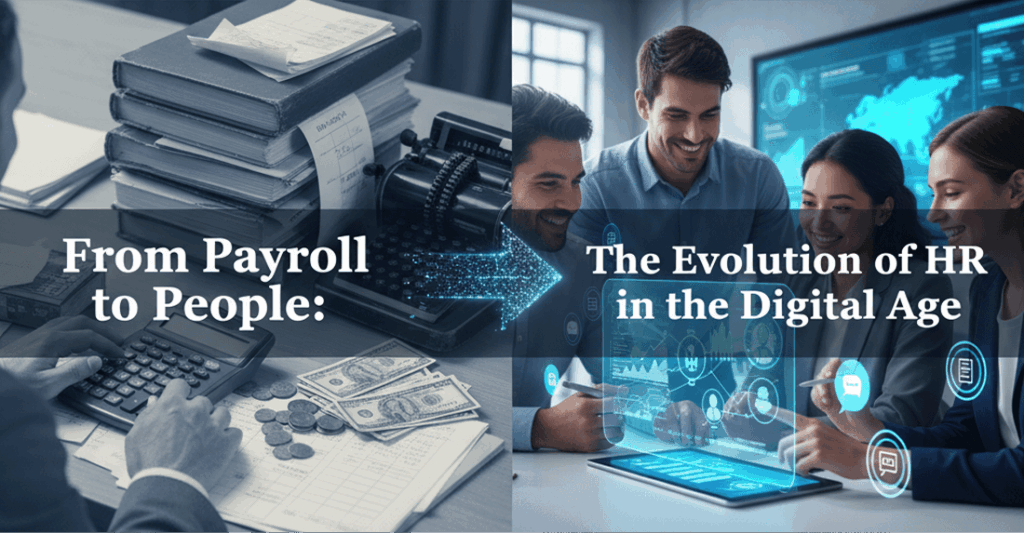

For decades, the Human Resources (HR) function was largely relegated to the role of a “record-keeper.” It was the department burdened with the meticulous, often tedious, tasks of payroll processing and compliance documentation. In this “old” HR era, the function was seen as a necessary administrative evil, a back-office operation bogged down in paperwork and lacking any real opportunity for strategic input or innovation.
The focus was on ensuring everyone was paid, paperwork was filed correctly, and basic rules were followed. However, this landscape has been updated in a significant way. Now, thanks to a monumental digital shift, in an era where technology enables HR’s transformation from a transactional and paper-based function to a strategic, people-centric powerhouse with a seat at the table of business strategy, offering business solutions.
The Old HR: A World of Paper and Tedium
Not many years ago, an HR professional’s work lifecycle was dominated by administrative tasks. Picture a desk filled with the following paper forms: timesheets, leave requests, expense reports, new hire packets, and other miscellaneous paperwork.
Most of an HR professional’s day-to-day work was on a laptop, performing the following administrative duties:
-
Manual Payroll Calculations
Payroll calculations for salaries, bonuses, and deductions, either based on responses or basic spreadsheets, were time-consuming and error-prone.
-
Approval Chasing
Getting approvals with multiple parties for leave requests, performance reviews, and policy approvals with a physical paper trail for each exchange had to be manually processed, which led to back follow-ups and ultimately long delays in completing the approval process.
-
Actual File Management and Tracking
Employee files, contracts, and confidential documentation were with more than one student in each filing cabinet, which, with only a handful of employees, had been manageable, but a daunting, tedious personal treasure hunt for the HR professional with many more to find all within just 48 hours since the last HR task started.
-
Reactive Process
With so many tasks administratively keeping each HR professional so occupied daily, this hindered and limited the professional to individually the process reactively to each process individually that needed to be managed.
The Digital Shift: Automation as an Enabler
The introduction of contemporary HR Software (HRIS) and cloud-based solutions has been by far the biggest driver of change. The switch to digital processes has been a game-changer. For example, what used to take two days, or even two weeks, to accomplish now takes place in not more than two minutes – with dramatically enhanced accuracy and visibility.
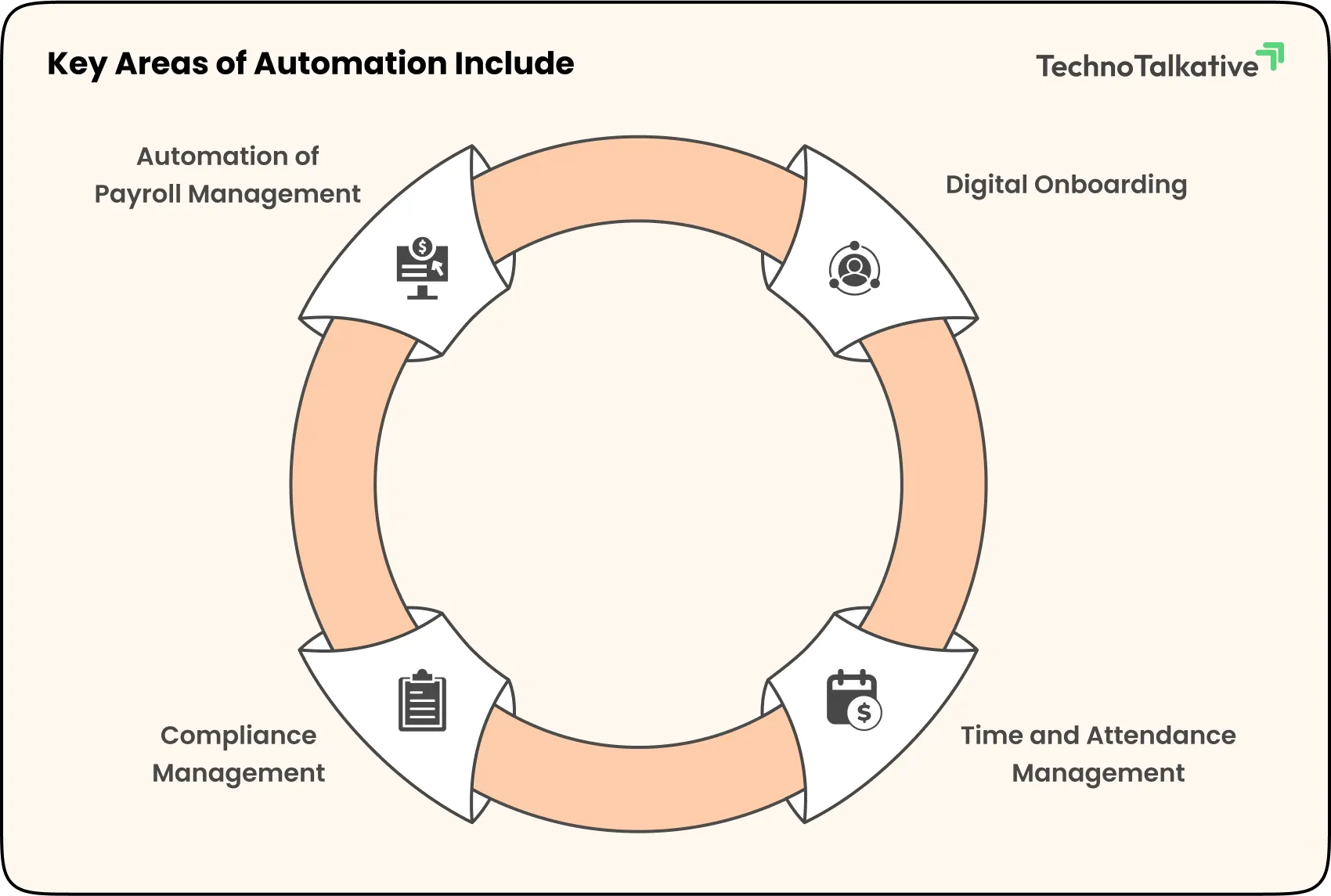
Key areas of automation include:
-
Automation of Payroll Management
Processing payroll for employees is becoming complicated, time-consuming, and prone to human error. HR can automate payroll calculations, tax withholdings, and employee direct deposit accounts with the click of a mouse, thereby removing prolonged human errors associated with payroll practices.
-
Digital Onboarding
Rather than disparate files, new hire documents are kept digitally in an easy-to-use online portal. Benefits enrollment and new hire policy acknowledgement can be informed through the online portal. Making a seamless and warm welcome to the new employee at the company.
-
Time and Attendance Management
Employees are advised to clock in and clock out using their phones or biometrics. Employee time reports sync the payroll system, which means time and attendance reports are clean and understandable, eliminating manual time cards, timesheet errors, and data entry errors.
-
Compliance Management
Automated reports or alerts remind HR professionals of ever-changing employment law regulatory measures. They gain peace by keeping track of compliance or reducing liability risk to the company through automation.
This is more than efficiency; it is empowerment. With less committee management of hiring, payroll, time and attendance, and employment law, HR teams can now prospectively organize policy, build company culture, and align workforce strategy with the employment policy.
From Payroll to People: The Core Transformation
The greatest change has been a fundamental change in mindset; it shifts in focus from transactions to people. Payroll and compliance are still very important, but not the main priority. Human Resources today encompasses the complete employee journey, from the moment the candidate applies to the day the employee retires. We focus on the employee experience to help each employee feel valued, supported, and engaged
This people-first approach can be seen in a couple of key aspects
1. Enhanced Employee Experience (EX)
The digital devices that streamline HR transactions often contribute to a better employee experience. Self-service portals allow employees to modify their own personal information, request time off, and retrieve pay stubs and benefit information at their convenience.
2. Engagement & Retention
Rather than being preoccupied with paperwork, HR teams now have the time to measure and improve the level of employee engagement that they have. HR teams can employ pulse surveys and analyze employee voice data to determine employee temperature, proactively identify issues, and create initiatives to build morale and well-being. This emphasis on engagement is a powerful weapon for retention in an employee market.
3. Strategic and Data-Driven Decision Making
The digital evolution of HR has moved from an anecdotal function to a data-informed engine that is truly its catalyst for decision making. Analytics dashboards provide almost real-time data on some of the key workforce trends that are taking place, including
- Attrition Data: HR can go through attrition data for departments, job positions, or managers to identify problem areas and proactively put retention effort plans in place before attrition takes place.
- Performance Data: Data collected from performance management systems can identify high-performing teams, specific skills gaps, training, and development efforts.
- Future Workforce Needs: Analytics will reveal future workforce needs for HR to anticipate talent acquisition and succession planning more strategically, as opposed to relying solely on intuition.
This ability to turn data into actionable insights means HR can now make recommendations to leaders based on evidence, as opposed to relying on gut instinct and having a truly robust partnership strategically.
Why This Evolution Matters for Organizations
In a highly competitive labor market, organizations that leverage this disruption win out. When HR can allocate less time to administrative matters and more time to doing what their role should be, the workplace will become people-centered, resulting in more happy, engaged, and involved people. Ultimately, this will help drive better organizational performance. Employees who feel appreciated and involved are more productive, more innovative, and more loyal – which ultimately leads to lower rates of attrition, lower recruitment expenditure, and a more extensive and resilient organizational culture.
HR’s redesigned strategic role is focused on establishing a sustainable foundation for growth. This demonstrates compensation and total rewards designed to attract awesome talent, developing learning and development programs to ensure an employee workforce ready to grow, and endorsing DEI programs to have a stronger talent pool that reflects the demographics of the community where you operate.
Looking Ahead: The Future is Now
The shift to digital in HR will surely continue. Another wave of this transformation has now begun, driven by technologies such as artificial intelligence (AI), machine learning (ML), and predictive analytics.
-
AI in Recruiting
Organizations began to leverage AI to screen and rank resumes, facilitate or even conduct first-stage interviews, and suggest candidates that might click with the culture/job, while attempting to diminish or avoid bias in recruitment.
-
Predictive Attrition Modeling
AI algorithms can assess countless data points within the employee framework in your organization to forecast those who are more likely to leave, or to develop proactive retention interventions by category.
-
Tailored Learning
ML is being utilized to support and recommend employee training and skills development, which will improve employees’ capabilities to grow and get promoted.
HR leaders of tomorrow will not only need to be people experts but will also need to be data- and technology-literate. In the future, those who are successful in HR will have the capacity to blend empathy and emotional intelligence and have a background, if not expertise, in data analytics.
One thing is now apparent: HR has gone beyond payroll administration. In a digital landscape, HR is no longer about administering tasks and transactions; HR is now about bringing people to the forefront of business and leveraging technology so that people can operate at their highest level. This is not merely an evolution; it is a complete redefinition of the HR practice for the 21st century