
Key Takeaways for Developers & Founders
Syntax vs. Intent: AI tools like Claude, Cursor and GitHub Copilot have automated the “mechanical” noise of coding (boilerplate, testing, documentation), shifting the developer’s primary value from writing syntax to architectural auditing and high-level system design.
Privacy-First Innovation: On-device models like Gemini Nano and ML Kit have enabled a new standard of Edge AI. This allows founders to ship zero-latency, offline-capable, and privacy-secure features that were previously cost-prohibitive or technically impossible.
Strategic ROI: AI-augmented teams in 2026 are leaner and faster, effectively doubling innovation capacity. Founders must prioritize AI that solves genuine user friction over “bolted-on” gimmicks to maintain a long-term product moat.
Impact of AI Mobile App Development, App Developers, and Founders
Over the past few days, I have been documenting the evolution of mobile ecosystems from a personal lens, first reflecting on my journey starting in 2009 in Android Development History and then exploring the high-velocity reality of Modern Android Development in 2026.
In both discussions, AI surfaced as a recurring theme. It was deliberate. AI’s impact is too significant to be a sidebar; it requires its own dedicated space. This is that space.
The 2026 Paradigm Shift
While AI isn’t a new concept in tech, the velocity and breadth of its integration over the last three years represent a fundamental shift. We aren’t just looking at a new IDE plugin; we are witnessing a transformation that touches every layer of the mobile stack.
To build a coherent strategy, both developers and founders must separate this shift into two distinct dimensions:
- AI as a Development Tool: How we write code, debug at scale, and ship features with increased velocity.
- AI as a Product Capability: How apps themselves think and interact, and what this means for long-term product strategy.
Conflating these two leads to confused roadmaps. Below, I break down why both matter, but in very different ways, to the people building the future of mobile.
AI as a Development Tool: The Shift from Autocomplete to Contextual Logic
In 2026, the “AI as a tool” conversation has moved past the novelty of early GitHub Copilot. We have shifted from predictive typing to contextual reasoning. Today’s AI tools don’t just guess the next line; they understand your entire project’s dependency graph, local architectural patterns, and specific API versions.
1. Eliminating “Mechanical” Engineering
The most significant impact for Android developers is the near-total automation of boilerplate code. By offloading high-repetition tasks, senior developers can reallocate their cognitive load toward high-level system design.
- Scaffolding: Instant generation of ViewModels, Data Classes, and Repositories.
- UI Declarations: Rapidly drafting Jetpack Compose composables for standard UI patterns.
- Documentation: Real-time generation of technical documentation and KDoc comments based on code intent.
2. Intelligent Debugging and RCA (Root Cause Analysis)
Debugging is no longer just about reading stack traces. Modern AI-assisted tools cross-reference your specific error against millions of similar, anonymized codebases to identify probable causes.
| Feature | Impact on Workflow |
| Stack Trace Analysis | Maps crashes to known lifecycle issues or threading conflicts. |
| Automated Unit Testing | Generates edge-case tests for repositories and logic-heavy ViewModels. |
| Memory Leak Detection | Flags potential leaks during the coding phase rather than in production. |
3. The New Standard for Code Reviews
AI has become the first “gatekeeper” in the Pull Request (PR) process. By the time a human reviewer opens a PR, the AI has already conducted a “Quality Pass” to identify:
- Performance Bottlenecks: Identifying sub-optimal loops or unnecessary recompositions.
- Security Vulnerabilities: Flagging insecure data handling or deprecated API usage.
- Architectural Drift: Notifying the team if the new code violates established project patterns (e.g., bypassing a domain layer).
It is critical to maintain a distinction: AI makes good developers faster; it does not make inexperienced developers good.
The true value of a developer in 2026 isn’t the ability to write code but the ability to audit it. AI cannot yet navigate the nuanced trade-offs of a complex mobile ecosystem or predict how a specific architectural choice will scale two years down the line. That remains the domain of human experience.
AI as a Product Capability Advances Mobile Capabilities
The most consequential shift in mobile strategy today isn’t just how we write code, but what that code is capable of delivering. In 2026, we have moved beyond simple “smart” features into a world of proactive, privacy-first intelligence.
The Rise of On-Device AI (Edge AI)
For years, Android developers relied on ML Kit and TensorFlow Lite for basic machine learning. However, the introduction of Gemini Nano, Google’s most efficient LLM built specifically for on-device tasks, has fundamentally changed the landscape.
Why On-Device AI is the 2026 Gold Standard:
- Zero-Latency: No round-trip to a server means real-time responsiveness.
- Privacy by Design: Sensitive user data never leaves the device, a critical factor for Health-Tech and Fintech.
- Offline Functionality: Features like real-time translation or voice command work without a network connection.
Practical Use Cases of AI in App Development
AI has removed the technical entry barrier in app development. The challenge for founders today is not “Can we build it?” but “Should we build it?”
| Capability | On-Device (Gemini Nano / ML Kit) | Cloud-Based (Gemini Pro / GPT-4) |
| Summarization | Instant recap of chat threads/emails. | Deep analysis of massive document sets. |
| Personalization | Adaptive UIs based on local habits. | Global recommendation engines (e.g., Netflix style). |
| Vision | Real-time object/text OCR. | Complex generative image creation. |
| Interaction | Low-latency voice commands. | Open-ended conversational “agents.” |
In the past, high-level personalization was a moat held only by giants like Netflix or Spotify. With the maturity of AI SDKs and Firebase Genkit, even small product teams can now implement RAG (Retrieval-Augmented Generation) to create apps that adapt their interface and content to individual user intent in real-time.
The Evolution of Natural Language Interfaces (LUI)
Voice interaction has evolved from rigid “If-This-Then-That” commands to fluid Natural Language Interfaces (LUI).
- In 2024: Users followed the app’s navigation.
- In 2026: Users describe their intent (e.g., “Show me all my expenses from last Tuesday’s business dinner”), and the app navigates for them.
The technical moat has lowered, but the product moat has grown. Founders who integrate these capabilities into the core user journey rather than bolting them on as gimmicks will be the ones who maintain a competitive edge in the 2026 app market.
Key Definitions for Reference:
- Gemini Nano: Google’s compact LLM designed to run locally on Android hardware.
- ML Kit: A mobile SDK that brings Google’s machine learning expertise to Android and iOS apps.
- Edge AI: The practice of running AI algorithms locally on a device rather than on a centralized cloud server.
How Founders Should Integrate AI in Their App Development Strategy
As a Co-Founder and CEO who advises business leaders on mobile product strategy, I’ve seen the conversation shift from “What is AI?” to “How do we build an AI-first roadmap that actually scales?” For founders, the challenge is separating the marketing hype from genuine product value.
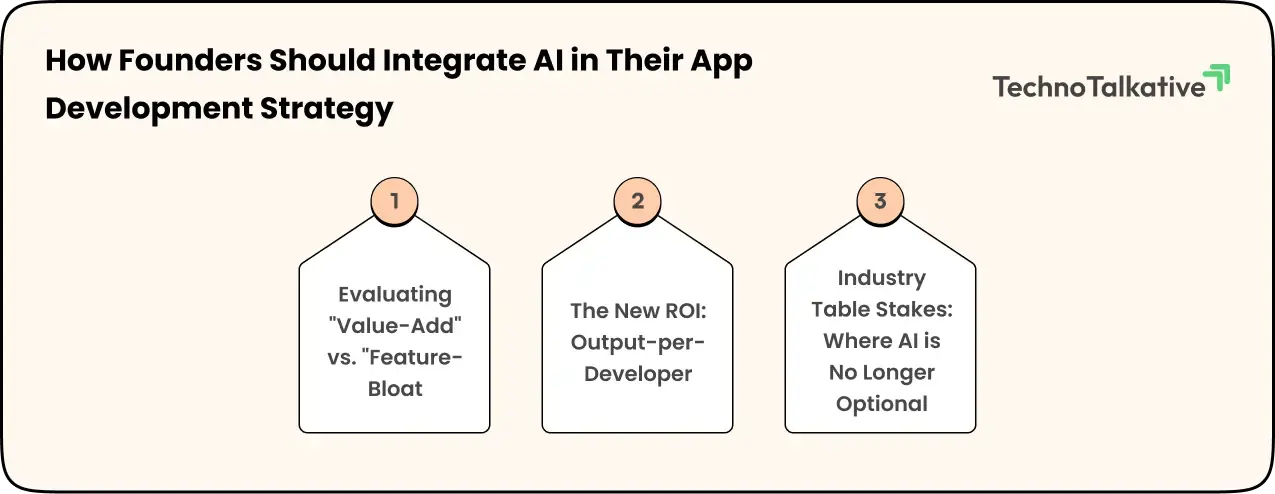
1. Evaluating “Value-Add” vs. “Feature-Bloat.”
The most successful AI integrations in 2026 are invisible; they solve friction without the user ever needing to know “AI” is behind it. Conversely, “bolted-on” AI, like generic chatbots, often erodes user trust.
Use this 3-point checklist to evaluate every AI feature request:
- Friction Reduction: Does this feature eliminate a manual step in the user journey (e.g., auto-categorizing expenses in a finance app)?
- Cognitive Load: Does it handle complexity on behalf of the user (e.g., summarizing a long fitness training history into a single insight)?
- Contextual Relevance: Is the AI response based on real-time user behavior or just generic, static prompts?
2. The New ROI: Output-per-Developer
The productivity gains from AI development tools (like GitHub Copilot and Cursor) have changed the math of mobile team scaling.
| Dimension | Legacy Team Structure | AI-Augmented Team (2026) |
| Velocity | Limited by manual boilerplate/testing. | Rapid prototyping and automated QA cycles. |
| Team Size | Larger teams are required for scale. | Leaner, high-seniority teams moving faster. |
| Skill Mix | Heavy focus on syntax and implementation. | Focus on Architecture, Security, and Prompt Engineering. |
You may not need fewer developers, but your current team’s capacity for innovation has effectively doubled. Founders must re-baseline their roadmaps to account for this increased velocity.
Check out the guide for founders on how to integrate AI in their apps.
3. Industry Table Stakes: Where AI is No Longer Optional
In several mobile categories, AI integration has moved from “delighter” to competitive necessity. If you are building in the following spaces, a lack of AI is now a product liability:
- Health & Fitness: Moving from static tracking to Intelligent Coaching.
- Fintech: Moving from transaction lists to Predictive Insights.
- Productivity: Moving from manual inputs to Context-Aware Suggestions.
“AI for marketing” is a short-term play. “AI for UX” is a long-term moat. If you can’t identify a specific moment in your user journey where AI makes the experience feel simpler, it’s likely a trend you should avoid chasing until the use case matures.
Mobile App Development in the Age of AI
The trajectory for 2026 and beyond is unmistakable. We are moving toward a symbiotic relationship where AI handles the syntax, and humans handle the intent.
1. The Evolution of User Expectations
As on-device hardware improves, “intelligent” features will stop being a luxury. Whether you are building native Android or following modern Flutter development trends, AI integration is now a first-class citizen.
2. The Shifting Developer Skillset
Deep platform knowledge (Android internals, memory management, and system architecture) remains the foundation. However, a new layer of “AI Literacy” is now mandatory for the professional developer.
| Core Skill (Human) | AI-Augmented Skill (2026) |
| Manual Coding | Prompt Engineering & Logic Auditing |
| Debugging | AI-Assisted Root Cause Analysis |
| Standard UI Design | Natural Language Interface (LUI) Design |
| System Architecture | AI Infrastructure & Cost Modeling |
3. The Strategic Imperative for Founders
Product strategy now requires an “AI Point of View.” You don’t need an AI feature in every corner of your app, but you do need to know why you are (or aren’t) using it. A strategy based on user pain points rather than industry FOMO is your most significant competitive advantage.
AI will not replace the skilled mobile developer. Instead, it is raising the bar. The developers and founders who thrive will be those who use AI to remove the mechanical “noise” of development, allowing them to focus entirely on the “signal” of innovation.
Is “Vibe Coding” the End of Engineering?
In the next part of this series, I’m diving into the most controversial trend of the year: Vibe Coding. Definition: Vibe Coding refers to the practice of building complex software by describing high-level intent to an AI, rather than writing line-by-line code.
Is it a threat to professional craftsmanship or the ultimate opportunity for creators?