
Key takeaways
|
The rise of AI-assisted development, often called “vibe coding”, is reshaping how software is built. The idea is simple: describe what you want in natural language, let AI generate code, and iterate quickly.
The debate around this approach is polarised. Some believe it is the future of development, while others fear declining code quality and skill erosion. The reality is more balanced.
The truth is that AI is not replacing engineering; it is changing how engineering work is done.
What the Data Says About AI-Assisted Development
- Developers using AI coding tools report 20%–60% productivity improvement in routine tasks.
- Surveys in 2024–2025 show around 55%–70% of professional developers already use AI coding assistance.
- Boilerplate and repetitive coding tasks are the biggest areas for productivity gain.
Examples of real industry adoption:
- GitHub Copilot is used by millions of developers globally.
- OpenAI models power many modern coding assistants.
- Google integrates AI coding help in Android Studio workflows.
Developer Impact Augmentation, Not Replacement
AI tools are reducing the time spent on:
- CRUD backend scaffolding
- Basic UI implementation
- Test generation
- Documentation writing
But high-value engineering work still requires human judgement.
Hard problems AI struggles with today include:
- Multi-system architecture design
- Security validation
- Performance tuning at scale
- Legacy codebase reasoning
- Business logic ambiguity
Senior developers often gain the most because AI removes repetitive work and frees time for design and architecture thinking.
Where Vibe Coding Works Well
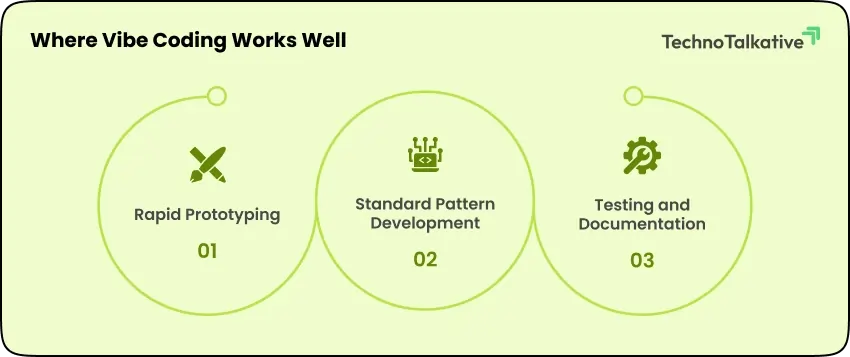
1. Rapid Prototyping
Location trend: Startups in the United States, India, and Southeast Asia are using AI coding tools for MVP creation.
Typical use cases:
- Product idea validation
- Investor demo builds
- UI experimentation
Example: Many early-stage SaaS startups can now build working prototypes within 24–72 hours instead of weeks.
2. Standard Pattern Development
AI performs well when code patterns are common and well-documented.
Examples:
- Form validation modules
- List-detail UI flows
- Authentication scaffolding
Large platforms already automate similar workflows internally.
3. Testing and Documentation
AI is particularly strong at generating:
- Unit test templates
- Code explanation summaries
- Onboarding documentation
This is valuable because developers often underwrite testing work due to time pressure.
Where Vibe Coding Goes Wrong for Developers
-
Security Risks
AI-generated code can introduce hidden vulnerabilities.
Common risks:
- SQL injection patterns
- Weak input validation
- Over-permissive API exposure
Security review is mandatory for production systems.
-
Architecture Drift
Speed-focused coding can create technical debt.
If prototype code is moved directly to production:
- Performance bottlenecks may appear when user scale grows.
Example real-world concern:
- Startup products built quickly in India and Eastern Europe using AI prototypes sometimes require refactoring after reaching 50K–100K active users.
-
Complex System Integration
AI often generates code that works in isolation but fails in real runtime environments.
Typical failure zones:
- Mobile lifecycle management
- Background processing
- Distributed transactions
The Founder’s Lens: A Different Set of Questions Entirely
For founders, AI coding is primarily a market validation acceleration tool.
Advantages:
- Faster MVP launch
- Lower initial engineering cost
- Rapid feature experimentation
But production products still need professional engineering oversight.
Prototype tools like AI code builders are excellent for concept validation, but are rarely the final production foundation.
Realistic Industry Adoption Pattern
| Stage | AI Coding Usage |
| Idea Validation | Very High |
| MVP Development | High |
| Production Core Systems | Moderate |
| Safety-critical Systems | Low |
Industries such as fintech, healthcare, and compliance-heavy platforms still rely heavily on human engineering review.
The Question Both Lenses Are Really Asking
At its core, developers and founders are asking the same thing: how do I use AI tools effectively without being limited by their weaknesses?
For developers, success comes from strong foundational knowledge combined with AI as an accelerant, not a replacement for thinking. Review AI output critically and treat prompt skills as a support skill, not the main skill.
For founders, use vibe coding to explore ideas and validate early, but clearly separate prototypes from production products. Skipping proper engineering early may save time initially, but can create scaling, security, and maintenance costs later. AI development should help you do things more efficiently, not help you avoid engineering discipline.
My Honest Verdict
Vibe coding is real, useful, and here to stay, but it’s not a replacement for engineering. Non-technical founders can quickly ship MVPs or demos, which is powerful, but using it for complex systems like payments or healthcare is risky.
The winners will be those who use these tools wisely: enough skill to guide AI, catch errors, and know when code won’t hold in production. Founders can move fast and validate early, but there comes a point when real users, data, and edge cases appear, where you must switch from vibing to building properly. Recognizing that moment is critical.