

Flutter has come a long way since its early days as a mobile-first framework. In 2026, it has grown into a full-stack UI platform that lets teams ship apps across mobile, web, desktop, and even smart TVs from a single codebase. Startups are choosing Flutter more than ever for its speed, consistency, and cost efficiency. However, finding and hiring the right Flutter developers for your startup still requires a thoughtful approach.
This article will guide you through hiring the best Flutter app developers for your startup in 2026. From understanding what’s changed in the Flutter ecosystem this year to exploring offshore hiring strategies that work, we will cover everything you need to know to make confident hiring decisions.
Why are Flutter Developers in High Demand?
Flutter developers are in high demand, and the reasons go well beyond cross-platform convenience. The framework’s rendering engine, Impeller, is now the default on both iOS and Android, which means smoother animations and better performance out of the box. Stateful hot reload has extended to web, closing one of the biggest gaps developers had with Flutter on the browser.Beyond the technical upgrades, Flutter now supports building apps that respond to user intent through on-device machine learning and cloud-based AI services. Startups working on products that need chatbots, recommendation engines, or voice-driven interfaces are finding Flutter well-suited for these use cases. With a single codebase that covers mobile, web, and desktop, Flutter lets lean teams do more without needing separate specialists for each platform.
Benefits of Hiring Offshore Flutter Developers
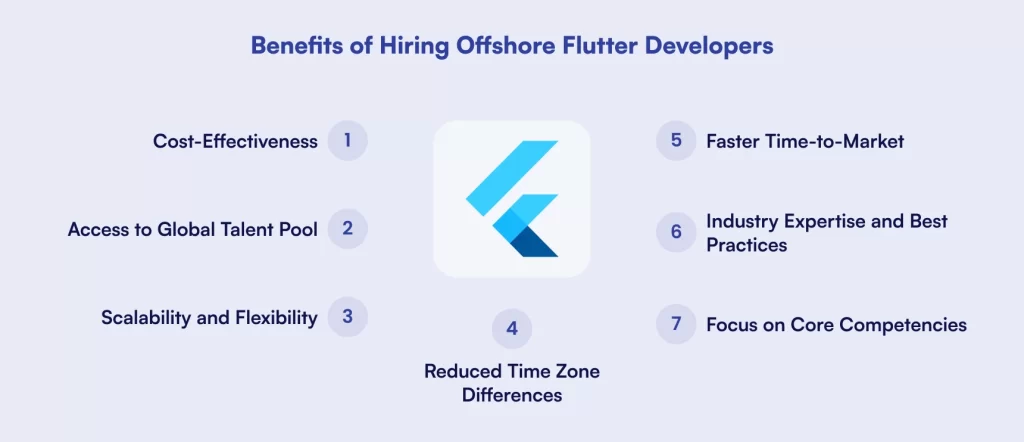
Hiring offshore Flutter developers offers several advantages for startups. It provides access to a global talent pool, enabling you to choose from experienced developers with diverse skill sets. Offshore hiring also offers cost-effectiveness, as it eliminates the need for setting up in-house infrastructure and reduces overhead expenses.
-
Cost-Effectiveness
One of the primary benefits of hiring offshore Flutter developers is cost-effectiveness. Offshore developers typically offer services at lower rates compared to their onshore counterparts. This cost advantage arises from differences in labor and operational expenses in various regions. By hiring offshore Flutter developers, startups can optimize their development budget without compromising quality. You can also go through the guide that depicts the cost of hiring Flutter developers in 2024.
-
Access to Global Talent Pool
Offshore hiring provides access to a vast global talent pool. Startups can choose from a diverse range of highly skilled Flutter developers with expertise in building cross-platform apps. This wider talent pool enables businesses to find developers with the specific skills and experience required for their projects. The global talent pool offers a variety of perspectives and approaches, fostering innovation and creativity.
-
Scalability and Flexibility
Offshore Flutter developers offer scalability and flexibility in terms of project requirements. Startups can easily scale their development team based on project needs, whether expanding or downsizing the team. Offshore development teams can quickly adapt to changing requirements and provide the necessary resources on demand. This flexibility allows startups to respond swiftly to market demands and achieve faster time-to-market.
-
Reduced Time Zone Differences
Offshore Flutter developers are often located in regions with overlapping or complementary time zones, making communication and collaboration easier. This minimizes potential delays and improves the overall efficiency of the development process. Teams can coordinate effectively, have real-time discussions, and promptly address issues. It enables seamless project management and ensures that development progress remains on track.
-
Focus on Core Competencies
By outsourcing Flutter development offshore, startups can focus on their core competencies and strategic business objectives. Rather than investing time and resources in recruiting, training, and managing an in-house development team, they can rely on offshore experts specializing in Flutter app development. This allows startups to allocate resources more efficiently and concentrate on areas critical to their business growth.
-
Industry Expertise and Best Practices
Offshore Flutter development companies often have extensive experience working with clients from various industries. They bring industry-specific knowledge, insights, and best practices to the table. By partnering with an offshore Flutter development company, startups can benefit from this expertise and leverage their experience to build robust, scalable, and user-friendly applications.
-
Faster Time-to-Market
Offshore Flutter developers are experienced in delivering projects within specified timelines. Their proficiency in Flutter development frameworks and agile methodologies allows for faster development cycles. With quicker iterations, frequent updates, and the ability to leverage Flutter’s hot reload feature, startups can accelerate their time-to-market and gain a competitive edge.
What are the Places to Find Experienced Flutter Developers?
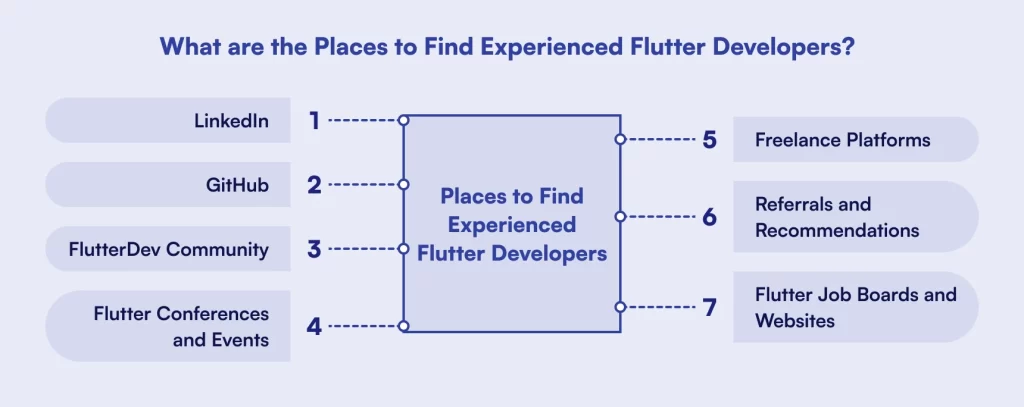
To find experienced Flutter developers, explore a mix of professional platforms, developer communities, and industry events. Platforms like LinkedIn and GitHub remain reliable starting points, while Flutter-specific communities and conferences allow you to connect with developers who are actively building with the framework. Additionally, partnering with a reputable Flutter Development Company can provide you access to a pool of highly skilled Flutter app developers who have been pre-vetted for quality and experience.
Here are the best online platforms to find professional Flutter developers
-
LinkedIn
LinkedIn continues to be one of the most effective platforms for finding experienced Flutter developers. Use the search function to identify developers who list Flutter and Dart among their skills, or browse through relevant Flutter development groups. You can post job listings, review candidates’ work history, and reach out to developers directly through the platform.
-
GitHub
GitHub is a popular platform for hosting and collaborating on software development projects. Many experienced Flutter developers showcase their work and contribute to open-source Flutter projects on GitHub. Explore Flutter-related repositories, review developers’ commit history and pull requests, and assess how actively they contribute to the community. A developer with a well-maintained GitHub profile often demonstrates a strong commitment to their craft.
-
Dev.to and Medium
Both Dev.to and Medium host active Flutter developer communities where experienced developers regularly publish tutorials, case studies, and architectural breakdowns. Reviewing a developer’s published articles can give you a clear picture of how they think through problems, how well they communicate technical ideas, and how engaged they are with the Flutter ecosystem. These platforms can be especially useful for identifying self-driven candidates who go beyond their day-to-day work to share knowledge with others.
-
FlutterDev Community
FlutterDev is a vibrant online community of Flutter developers. The community spans forums, discussion boards, and platforms like Stack Overflow dedicated to Flutter development. Engage in discussions, seek advice, and connect with experienced Flutter developers who are actively participating. FlutterDev is a valuable resource for finding talented developers and staying updated on Flutter app development trends and best practices.
-
Flutter Conferences and Events
Attending Flutter conferences, meetups, and events is one of the best ways to network with developers who are serious about the framework. The conference landscape has evolved in 2026. FlutterCon and Droidcon have come together under a new umbrella event called Next.app DevCon, taking place in Berlin from October 7–9, 2026. This event brings Flutter, Android, React Native, iOS, and AI developers together in one place. FlutterCon USA has moved to Orlando, Florida, and Google I/O 2026, scheduled for May 19–20, typically features Flutter sessions and major framework announcements. These events provide excellent opportunities to meet developers in person, learn from their work, and build lasting professional relationships.
-
Freelance Platforms
Freelance platforms such as Upwork, Freelancer, and Toptal continue to offer access to a wide pool of talented Flutter developers. These platforms allow you to post your project requirements, review developer profiles and past work, and communicate directly with potential candidates. They are particularly useful for short-term projects, specific feature builds, or when you need to onboard a developer quickly.
-
AI-Powered Hiring Platforms
A growing number of hiring platforms now use AI-driven matching to connect startups with vetted Flutter developers. Platforms like Index.dev and Arc.dev offer pre-screened candidates with verified technical skills and can match you with suitable developers within days rather than weeks. These platforms are worth considering if speed and quality of hire are priorities for your startup.
-
Referrals and Recommendations
Reach out to your professional network and ask for referrals or recommendations for experienced Flutter developers. Colleagues, industry contacts, and fellow developers who have previously worked with Flutter talent can provide useful insights into a candidate’s skills, work ethic, and reliability. Personal recommendations often surface candidates you would not find through job boards alone.
-
Flutter Job Boards and Websites
Dedicated Flutter job boards connect developers with relevant opportunities. FlutterJobs.com remains an active platform where you can post listings and search for developers by skill and experience. Additionally, general developer job boards like WeAreDevelopers and ZipRecruiter carry a growing number of Flutter-specific job listings. Explore these platforms to widen your reach when hiring.
Remember to assess developers’ portfolios thoroughly, review their past projects, and conduct interviews to ensure they meet your specific requirements. Combining multiple approaches, leveraging professional networks, attending events, and using dedicated platforms will increase your chances of finding experienced Flutter developers who align with your startup’s needs.
Must-have Technical Skills to Look for in a Flutter Developer
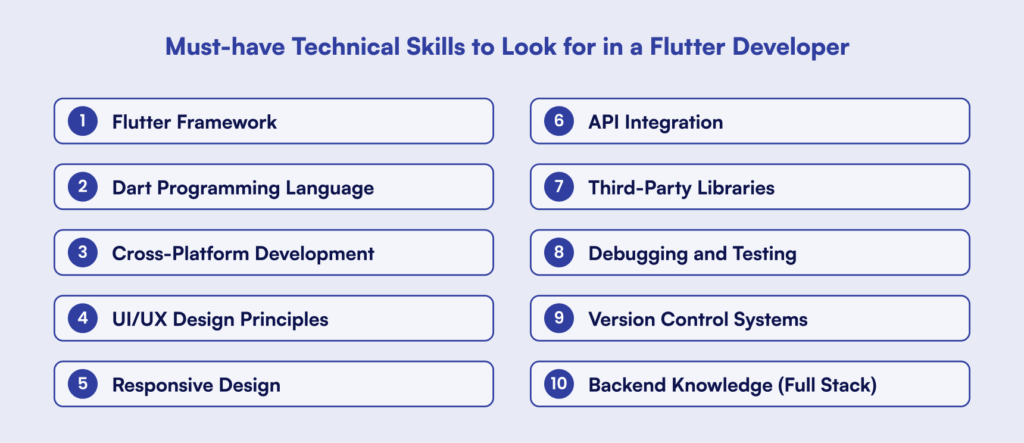
When hiring Flutter developers in 2026, the skills you should evaluate have shifted considerably. Beyond the fundamentals of Flutter and Dart, you need developers who understand the framework’s rendering engine, can work across multiple platforms, and know how to bring AI-powered features into your product. A developer with backend capabilities in Dart and experience with modern state management will be a strong asset for your startup.
Here are the technical skills to assess when evaluating Flutter developers:
Dart Programming Language (3.x and Beyond)
Dart has changed meaningfully over the past two years. Developers should be comfortable with features such as pattern matching, sealed classes, records, and the dot shorthand syntax introduced in Dart 3.10. These are not optional extras; they are part of how production-grade Flutter code is written today. A developer who writes modern Dart will produce cleaner, more maintainable code across your project.
Impeller and Rendering Performance
Flutter’s rendering engine, Impeller, is now the default on both iOS and Android. It replaces the older Skia engine and uses precompiled shaders to eliminate the animation stutters that used to affect first-run experiences. Look for developers who understand how Impeller works under the hood, how to profile frame rendering using DevTools, and how to identify bottlenecks during transitions and complex animations. This is no longer a nice-to-have; it is core knowledge.
Modern State Management
The Flutter community has largely settled its state management debates. Riverpod and BLoC have emerged as the go-to solutions for production apps. When evaluating candidates, pay attention to whether they can explain why they chose a particular state management approach for a given project. The ability to reason about state architecture, not just name a library, is what separates experienced developers from those who are still finding their footing.
Cross-Platform Development (Beyond Mobile)
Flutter now supports mobile, web, desktop, and embedded platforms from a single codebase. Verify that the developers have hands-on experience building for at least two of these surfaces. On the web, Flutter now supports stateful hot reload, making iteration much faster. For desktop, features like pop-up windows, dialog management, and multi-window support have reached a production-ready state. Google has also announced a collaboration with LG to bring Flutter to smart TVs. Developers who can think beyond mobile will help your startup reach more users without expanding your team.
AI and Machine Learning Integration
This is one of the most significant new skill areas for Flutter developers. Assess whether the candidate has experience connecting Flutter apps to AI and ML services such as TensorFlow Lite for on-device inference, Google ML Kit for features like text recognition and face detection, or Firebase’s Vertex AI services for building chat interfaces and running predictions. The Flutter AI Toolkit now provides pre-built components for conversational UIs and voice input. Developers who know their way around these tools can help your startup ship intelligent features faster and without building everything from scratch.
UI/UX Design Principles
Look for Flutter developers who have a good sense of UI/UX design principles. They should be able to create intuitive and visually appealing user interfaces that feel right on each platform. With Flutter’s Cupertino widgets now supporting features like squircle-shaped corners that match Apple’s native design language, developers who pay attention to platform-specific design details will deliver a noticeably better user experience.
API Integration
Assess their knowledge of integrating APIs and handling data exchange between the app and external services. Experience working with RESTful APIs remains important, but in 2026, look also for familiarity with GraphQL and Firebase’s AI SDK (formerly firebase_vertexai). Developers who have worked with the Dart and Flutter MCP Server for connecting to backend services and AI tools bring additional versatility to your project.
Full-Stack Capabilities with Dart
Consider developers who can handle both frontend and backend development using Dart. Dart Cloud Functions for Firebase now offer fast cold starts, making it practical to run backend logic in the same language as your app. A full-stack Flutter developer can manage end-to-end application development, which reduces the need for a separate backend team and keeps your architecture consistent. This is particularly valuable for startups operating with lean teams.
Debugging, Testing, and Tooling
Evaluate their expertise in debugging and testing Flutter applications. They should be proficient in using Flutter DevTools for profiling performance, memory usage, and widget rebuilds. The Widget Previewer tool, which now integrates with VS Code and Android Studio, is useful for reviewing UI components during development. Additionally, many teams now use AI-assisted testing workflows alongside traditional unit and integration tests. A developer who combines solid testing discipline with modern tooling will keep your app stable as it scales.
Familiarity with AI-Assisted Development Workflows
Developers in 2026 are increasingly using AI-powered coding assistants to speed up their work. Tools like GitHub Copilot, Gemini Code Assist, and Cursor can generate widget trees, suggest architectural patterns, and write boilerplate code. Look for candidates who are comfortable with these tools and who understand how to review and validate the output they produce. The developers who get the most out of AI assistance are those who already have strong fundamentals; they use these tools to move faster, not to fill gaps in their understanding.
Version Control Systems
Ensure that the developers are comfortable using version control systems like Git. Proficiency in collaborating with other team members through code repositories, branching strategies, and pull request workflows is essential for a smooth development process, especially in distributed or offshore teams.
By assessing these must-have technical skills in Flutter developers, you can ensure that you hire Flutter professionals with the expertise necessary to deliver high-quality, feature-rich, and scalable Flutter applications for your startup.
What Should be Your Approach Towards Hiring Flutter Developers?
When hiring Flutter developers, adopt a comprehensive approach. Before structuring your development process or defining hiring workflows, it’s helpful to master basic mind mapping to visualize candidate evaluation stages, required skill sets, and project dependencies. This helps startups plan recruitment more strategically. Clearly define your project requirements and assess candidates based on their experience, expertise, and technical skills. Conduct thorough interviews to evaluate their problem-solving abilities and communication skills. Collaborate closely with your development partner to ensure a seamless hiring process and find developers who align with your startup’s vision and goals.
Steps to Hire Professional Flutter Developers
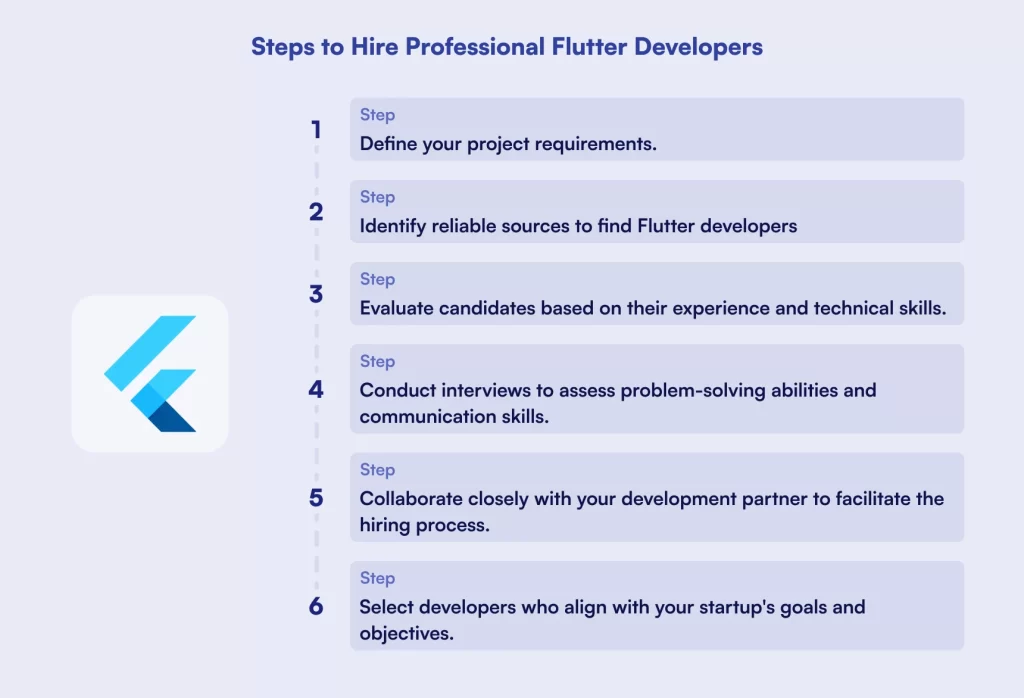
To hire Flutter developers, follow these steps:
- Define your project requirements.
- Identify reliable sources to find Flutter developers.
- Evaluate candidates based on their experience and technical skills.
- Conduct interviews to assess their problem-solving abilities and communication skills.
- Collaborate closely with your development partner to facilitate the hiring process.
- Select developers who align with your startup’s goals and objectives.
-
Define your project requirements.
Before hiring Flutter developers, clearly define your project requirements. Determine the project scope, specific features and functionalities you need, and any technical specifications. This will help you communicate effectively with potential developers and ensure they understand the project’s objectives and deliverables.
-
Identify reliable sources to find Flutter developers
Research and identify reliable sources to find Flutter developers. This can include online platforms such as LinkedIn, GitHub, FlutterDev community forums, and freelance platforms. Explore their profiles, portfolios, and reviews to gauge their experience and expertise in Flutter development.
-
Evaluate candidates based on their experience and technical skills.
Evaluate candidates based on their experience and technical skills. Look for developers with a proven track record of working on Flutter projects. Assess their expertise in Flutter framework, Dart programming language, UI/UX design principles, and knowledge of integrating APIs and third-party libraries. Consider their previous projects and client testimonials to gain insights into their capabilities.
-
Conduct interviews to assess problem-solving abilities and communication skills.
Conduct interviews with shortlisted candidates to assess their problem-solving abilities and communication skills. Ask them to explain their approach to solving complex development challenges and evaluate their ability to communicate technical concepts. Assess their compatibility with your team’s communication style and determine if they can effectively collaborate with your startup.
-
Collaborate closely with your development partner to facilitate the hiring process.
If you partner with a development company, collaborate closely with them to facilitate the hiring process. Share your project requirements, discuss your preferences and expectations, and provide additional information. A reliable mobile app development partner will assist you in finding the right Flutter developers who align with your project goals and requirements.
-
Select Flutter developers who align with your startup’s goals and objectives.
Select developers who align with your startup’s goals and objectives. Consider their experience, technical skills, cultural fit, and commitment to delivering high-quality results. Look for developers who demonstrate a passion for Flutter development and a willingness to contribute their expertise to your startup’s success.
By following these steps, you can streamline the process of hiring professional Flutter developers who are well-suited to meet your startup’s specific needs and contribute to the successful execution of your project.
Key Engagement Models Before Selecting Flutter Programmers
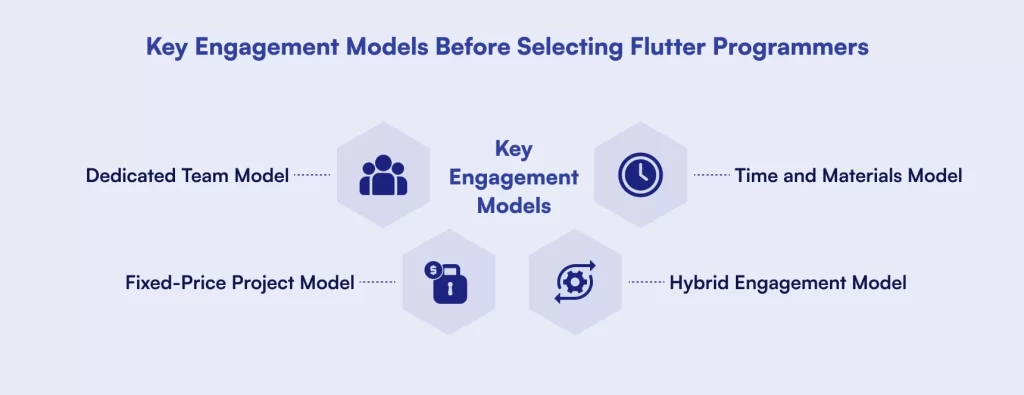
When selecting Flutter programmers, consider engagement models that align with your project requirements. Common engagement models include dedicated teams, fixed-price projects, and hourly rates. Evaluate the pros and cons of each model, and choose the one that suits your startup’s needs in terms of budget, project scope, and flexibility.
-
Dedicated Team Model
The dedicated team model involves hiring a dedicated team of Flutter programmers who work exclusively on your project. This model offers high control and flexibility as the developers become an extension of your in-house team. You have direct communication with the team members, and they focus solely on your project, ensuring dedicated attention and faster development cycles. This model is suitable for long-term projects with evolving requirements, as it allows for scalability and easy adaptation to changing project needs.
-
Fixed-Price Project Model
In the fixed-price project model, the Flutter development company provides a detailed project scope and timeline and a fixed price for the entire project. This model is suitable when the project requirements are well-defined and unlikely to change significantly. It offers cost predictability and is beneficial for startups with a fixed budget. However, it provides limited flexibility for accommodating changes or additions to the project scope once the contract is signed.
-
Time and Materials Model (Hourly Rates)
The time and materials model involves paying Flutter programmers based on the hours worked. This model offers flexibility, allowing for dynamic project requirements and scope changes. Hourly rates are agreed upon, and you are billed for the developers’ actual hours. This model suits startups with evolving project requirements or those seeking greater flexibility regarding scope adjustments. It provides the ability to track progress and make modifications as needed closely.
-
Hybrid Engagement Model
The hybrid engagement model combines aspects of both the dedicated team and fixed-price project models. It offers flexibility regarding team scalability while maintaining a fixed budget for a predefined scope of work. In this model, you have a core dedicated team working on your project, while additional resources can be added as required. The hybrid model strikes a balance between control and cost predictability, making it suitable for projects requiring some flexibility while maintaining budget constraints.
Each engagement model has its advantages and considerations. Evaluating your project’s specific requirements, budget constraints, and flexibility needs is essential to selecting the most appropriate engagement model when hiring Flutter programmers. Discussing these options with your app development partner can help you determine the best fit for your startup and ensure a successful collaboration.
How Much Does it Cost to Hire Flutter Developers?
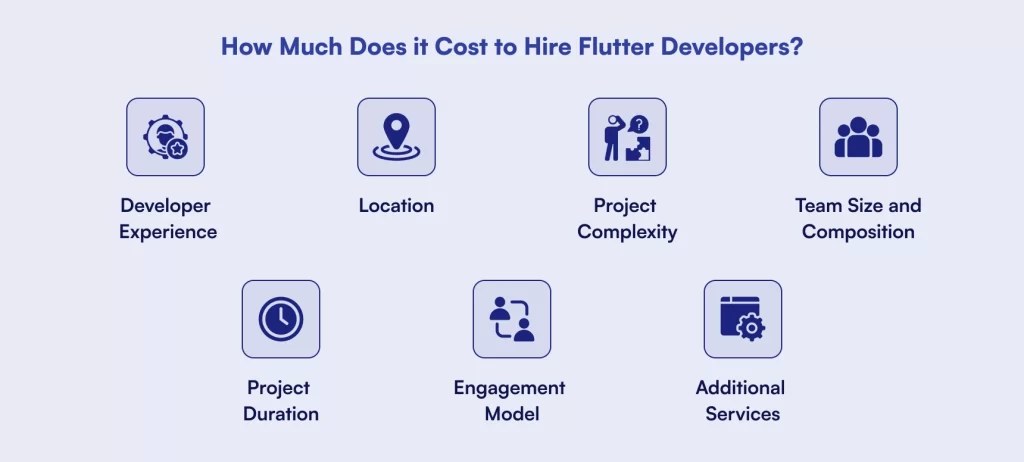
The cost of hiring Flutter developers can vary depending on their experience, location, and project complexity. Offshore hiring, like partnering with top Flutter development companies, offers cost-effective solutions without compromising quality. It eliminates expenses associated with setting up an in-house team and provides access to skilled Flutter developers at competitive rates.
Here are some key factors that can affect the cost of hiring Flutter developers:
-
Developer Experience
The Flutter developer’s level of experience and expertise plays a significant role in determining the cost. Developers with extensive experience and a strong track record of delivering successful Flutter projects tend to command higher rates. They bring valuable insights, best practices, and efficient problem-solving abilities.
-
Location
The geographical location of the Flutter developers can impact the cost. Rates can vary significantly based on regional market conditions and the cost of living. Hiring developers from regions with a lower cost of living, such as India, can often result in cost savings without compromising quality.
-
Project Complexity
The complexity of your project can influence the cost of hiring Flutter developers. Projects with intricate features, customizations, or integrations may require developers with specialized skills, which can affect the overall cost. Highly complex projects may require more experienced developers or a larger team, leading to higher costs.
-
Team Size and Composition
The size and composition of the Flutter development team you require will impact the cost. Hiring a dedicated team or multiple Flutter developers will incur additional costs than hiring a single developer. The team’s composition, including roles such as UI/UX designers, quality assurance engineers, or project managers, will also contribute to the overall cost.
-
Project Duration
The duration of your project will influence the cost of hiring Flutter developers. Developers may charge based on hourly rates or project milestones. Longer-term projects may offer opportunities for negotiation or discounted rates, while shorter projects may require a higher hourly rate.
-
Engagement Model
The chosen engagement model can impact the cost as well. Different models, such as dedicated teams, fixed-price projects, or hourly rates, have varying cost structures. Evaluate the pros and cons of each model and choose the one that aligns with your project requirements and budget.
-
Additional Services
Consider any additional services or expertise you require alongside Flutter development, such as UI/UX design, backend development, or quality assurance. Including these services may increase the overall cost but can provide comprehensive solutions for your project.
Discussing your specific project requirements, budget, and expected timeline with potential Flutter development partners is important. They can provide you with a transparent breakdown of costs, help you choose the most suitable engagement model, and offer competitive pricing tailored to your startup’s needs.
Why is India Considered to be the Biggest Hub for Outsourcing Flutter Projects?
India is considered a hub for outsourcing Flutter projects due to several factors. India has a vast pool of highly skilled and talented software developers, including proficient Flutter developers. The country offers cost-effective solutions with competitive pricing compared to other regions. Indian developers are known for their strong technical expertise, dedication, and ability to deliver high-quality projects within stipulated timelines.
Moreover, India has a favorable time zone overlap with many Western countries, enabling efficient communication and collaboration. The presence of a robust IT infrastructure and a mature outsourcing industry further solidifies India’s position as a preferred destination for outsourcing Flutter projects.
Conclusion
Hiring the right Flutter developers is crucial for the success of your startup in 2026. The framework has grown well beyond mobile, and the developers you bring on board should reflect that. By understanding what Flutter looks like today, evaluating candidates on the skills that matter this year, and choosing the right engagement model, you can build a team that delivers results across every platform your product needs to reach.
Partnering with a top-rated Flutter development company gives you access to skilled and dedicated developers who can bring your startup’s vision to life. With the right team in place, you can move from idea to launch faster and with greater confidence. Find the right company, define your requirements clearly, and get started.
FAQs
1. What are the benefits of offshore Flutter programmers?
Offshore Flutter programmers offer several benefits for startups. Firstly, offshore developers often provide cost-effective solutions, allowing you to optimize your development budget. Additionally, offshore development provides access to a global talent pool, enabling you to choose from highly skilled Flutter developers with diverse expertise. Offshore developers are flexible, allowing you to scale your team based on project needs and respond quickly to market demands. Reduced time zone differences facilitate seamless communication and collaboration. Moreover, offshore developers bring industry expertise and best practices, ensuring the delivery of robust, scalable, and user-friendly applications.
2. Can I hire dedicated Flutter mobile app developers online?
Yes, top Flutter development companies offer dedicated Flutter mobile app developers for hire. You can hire Flutter developers who will work exclusively on your project, providing you with focused attention and expertise. Their dedicated Flutter developers have in-depth knowledge of the Flutter framework, Dart programming language, and cross-platform app development. They will collaborate closely with you to understand your project requirements and deliver customized solutions tailored to your startup’s needs.
3. How can I hire Flutter developers on demand?
Hiring Flutter developers on demand is made easy these days. The offshore companies offer flexible engagement models that allow you to hire Flutter developers per your project requirements. Whether you need a dedicated team, a fixed-price project model, or a time and materials model, these companies can cater to your hiring needs. Simply communicate your project requirements, preferred engagement model, and expected timeline to them, and they will help you promptly assemble a skilled team of Flutter developers.
4. Is it possible to build cross-platform apps using Flutter?
Yes, Flutter is a powerful framework for building cross-platform apps. With Flutter, you can write code once and deploy it on multiple platforms, including iOS, Android, web, desktop, and embedded devices. Flutter’s hot reload feature enables rapid iteration and development, saving time and effort. Its rich pre-built UI components and widgets help create visually appealing and responsive apps across platforms. Whether you need a mobile app or a multi-platform solution, Flutter provides the tools and capabilities to build high-quality cross-platform apps efficiently.
5. What technical skills should I look for when hiring Flutter developers?
When hiring Flutter developers, look for technical skills such as proficiency in the Flutter framework, Dart programming language, and experience developing cross-platform apps. Additionally, consider their expertise in UI/UX design principles, knowledge of integrating APIs and third-party libraries, familiarity with platform-specific features, and understanding of mobile app development best practices. Strong problem-solving abilities, attention to detail, and the ability to work with a team are crucial to ensure successful project execution.
6. What are the key engagement models offered by top companies?
The offshore companies offer key engagement models to suit your project requirements:
- Dedicated Team Model: They provide a dedicated team of Flutter developers who exclusively work on your project, offering scalability, flexibility, and close collaboration.
- Fixed-Price Project Model: This model ensures a fixed budget and well-defined project scope, making it suitable for startups with specific requirements and a fixed budget.
- Time and Materials Model (Hourly Rates): They offer hourly rates, providing flexibility to accommodate changing project requirements and scope adjustments.
7. How much does it cost to hire Flutter developers?
The cost of hiring Flutter developers from offshore companies depends on project complexity, duration, and the chosen engagement model. Top companies provide competitive pricing based on your specific requirements. To obtain accurate cost estimates, discussing your project details and expectations with their team is recommended. They will provide you with a transparent breakdown of costs and help you choose a cost-effective solution that aligns with your startup’s budget.
8. What version of Flutter should my team be using in 2026?
As of early 2026, the latest stable release is Flutter 3.41 paired with Dart 3.11. This release includes improvements to the rendering engine, modular design packages, and better support for desktop platforms. The Flutter team is also working toward Flutter 4.0, which may arrive by mid-2026, though no official release date has been confirmed. For production apps, sticking with the latest stable release is the recommended approach.
9. Should I look for Flutter developers with AI experience?
If your product roadmap includes features like chatbots, recommendation systems, or voice-driven interfaces, then yes, it is worth prioritising candidates with AI integration experience. Flutter’s ecosystem now includes tools that make it easier to connect apps to machine learning services. Developers who have worked with these tools can help your startup ship intelligent features without adding a separate AI team to your project.
10. Can Flutter be used for desktop and web applications?
Yes, Flutter supports building applications for Windows, macOS, Linux, and the web. Desktop support has matured considerably, with features like multi-window management and native dialog windows now available. On the web, Flutter now includes stateful hot reload, which significantly improves the developer experience during iteration. Startups building internal tools, admin panels, or SaaS dashboards alongside mobile apps can benefit from Flutter’s ability to share a single codebase across all these platforms.