
Key Takeaways
- Vibe coding is a development approach where you describe what you want in plain language, and AI generates the code. The term was coined by AI researcher Andrej Karpathy in early 2025 and was named Collins Dictionary Word of the Year for 2025.
- Non-developers are shipping real products using tools like Cursor, Lovable, Bolt.new, and Replit Agent. Y Combinator reported that 25% of its Winter 2025 batch had codebases that were 95% AI-generated.
- Vibe coding is excellent for prototyping, MVP validation, and internal tools. But AI-generated code contains roughly 1.7 times more major issues than human-written code, including 2.74 times more security vulnerabilities.
- The pragmatic path for founders: use vibe coding to validate fast and cheap, then bring in professional engineers when real users, real data, and real scaling requirements enter the picture.
- Vibe coding does not replace software engineering. It changes who can participate in the early stages of building software, which is a meaningful and genuinely useful shift.
I have spent the last 17 years writing code, reviewing code, and building teams that write code. When I first heard the phrase “vibe coding” in early 2025, my honest reaction was scepticism. The idea that you could describe an app in everyday language and have AI build it sounded like a promise made for conference stages, not for real products.
Then I watched it happen. A founder we were advising walked into a call with a working prototype of a task management app. She had built it over a weekend using Lovable. She is not a developer. Even though she has never written a line of code in her life. The app was rough around the edges, the database logic had issues, and it would not have survived real user traffic. But it existed. It worked. And it demonstrated her idea better than any pitch deck could.
That moment shifted my thinking. Not because vibe coding is going to replace professional engineering, it clearly will not. But it fundamentally changes who gets to participate in the first stage of building software. And that matters.
In my previous article on vibe coding and AI-assisted development for mobile developers, I explored this topic from a developer’s perspective. This article is different. This one is for the founders, the CEOs, the product managers, the marketing leads, and anyone who has an app idea sitting in their head but assumed they needed a technical co-founder to make it real.
What Is Vibe Coding? A Plain English Explanation
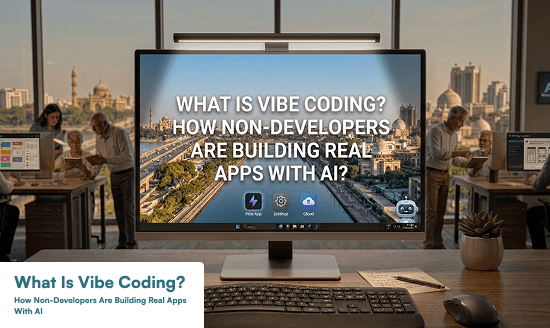
Vibe coding is a software development approach where you describe what you want to build in everyday language and AI generates the actual code for you. You do not need to understand programming languages, frameworks, or terminal commands. You describe your intent, the AI interprets it, and a working application begins to take shape.
The term was coined by Andrej Karpathy, a co-founder of OpenAI and former AI leader at Tesla, in February 2025. As he described it, the idea is to “fully give in to the vibes, embrace exponentials, and forget that the code even exists.” Collins Dictionary named it the Word of the Year for 2025.
In practical terms, here is how it works:
- Step 1: You describe your app in plain language. Example: “Build me a project tracker where users can create tasks, assign them to team members, and set deadlines.”
- Step 2: The AI tool generates the code, the file structure, the database models, and even a working user interface.
- Step 3: You review the output, test it in a live preview, and give the AI follow-up instructions. “Add a calendar view. Make the sidebar collapsible. Change the colour scheme to dark blue.”
- Step 4: The AI iterates. You keep refining until the app matches your vision.
That loop, describe, generate, refine, repeat, is the core of vibe coding. And it is now possible because the AI models powering these tools have reached a level of capability where they can generate genuinely functional code, not just snippets or templates, but entire working applications.
Why Is Vibe Coding Gaining Traction in 2026?
Three things converged to make this moment happen.
1. The AI Models Got Good Enough
Earlier AI coding assistants could autocomplete a line or suggest a function. The models available in 2026, including Claude, GPT-4o, and Gemini, can understand an entire project’s context, maintain consistency across files, and generate production-like code from natural language descriptions. The gap between what AI generates and what a junior developer writes has narrowed dramatically.
2. The Tools Became Complete Platforms
Vibe coding is no longer just a chat interface that outputs code. Platforms like Lovable and Bolt.new, Cursor, and Replit Agent handle the full stack: frontend, backend, database, authentication, and deployment. You can go from an idea to a live URL in a single session without touching any infrastructure.
3. The Numbers Made It Undeniable
According to the Stack Overflow 2025 Developer Survey, over 76% of developers are already using or planning to use AI coding tools.
Microsoft reports that AI now writes roughly 30% of its code. Google says more than a quarter of its code is AI-generated. Y Combinator reported that 25% of its Winter 2025 batch had codebases that were 95% AI-generated.
The vibe coding tools market reached an estimated $4.7 billion in 2025 and is projected to reach $12.3 billion by 2027. This is not a niche experiment anymore.
The Tools Non-Developers Are Actually Using
Not all vibe coding tools are the same. Some are designed for complete beginners, others are built for developers who want to move faster. Here is a practical breakdown:
| Tool | Best For | What It Does | Skill Level Needed |
| Lovable | Non-technical founders | Generates full-stack web apps from text descriptions. One-click deploy. | Zero coding knowledge |
| Bolt.new | Fast prototyping | Generates React/Next.js apps from a description. Deploy to Netlify instantly. | Zero to basic |
| Replit Agent | Beginners who want to learn | Full development environment with AI agent that builds, debugs, and deploys. | Zero to basic |
| v0 (Vercel) | Design-focused builders | Generates polished UI components and full-stack Next.js apps. | Basic understanding helpful |
| Cursor | Developers accelerating workflow | AI-native IDE with agent mode. Reads your codebase and makes context-aware edits. | Intermediate to advanced |
| Claude Code | Terminal-first developers | AI agent in your terminal. Reads files, runs tests, manages projects autonomously. | Advanced |
If you have never written code before and you want to test an idea, start with Lovable or Bolt.new. If you have a developer on your team who wants to move faster, Cursor is the standard choice in 2026.
What Non-Developers Are Actually Building
This is not theoretical. People without programming backgrounds are shipping real products:
- Internal business tools: Expense trackers, inventory dashboards, client onboarding forms, project management boards. These are tools that used to require a developer for a week and now take an afternoon.
- MVP products for market validation: Founders are building working prototypes to test with real users before investing in professional development. This is the single most valuable use case.
- Content and creator tools: Social media schedulers, thumbnail generators, AI-powered writing assistants, and podcast management dashboards.
- Small SaaS products: Niche subscription tools for specific industries, built and launched by solo founders.
There is a clear pattern here. Founders who use vibe coding for early-stage validation arrive at the professional development phase with significantly better product clarity. They have already tested their core assumptions. They know what their users want. The MVP development process becomes faster and more focused because the guesswork has already been removed.
Where Vibe Coding Breaks Down: The Honest Truth
This is the section most guides skip, and it is the one that matters most for anyone making real product decisions.
1. Security Vulnerabilities Are a Genuine Risk
A December 2025 analysis by CodeRabbit of 470 open-source GitHub pull requests found that AI co-authored code contained approximately 1.7 times more major issues than human-written code. Security vulnerabilities appeared at 2.74 times the rate. Misconfigurations were 75% more common.
If your app handles user data, payments, health information, or anything that requires trust, AI-generated code must be professionally reviewed before it goes anywhere near production.
2. Complexity Collapses Quickly
Vibe coding works well for the first 10 to 15 components of an application. Beyond that, things start to break. The AI loses context. Conflicting logic appears across files. Database relationships become inconsistent. What started as a smooth, conversational experience turns into a debugging marathon where you are trying to fix code you did not write and do not fully understand.
3. You Cannot Maintain What You Cannot Read
This is the fundamental constraint. When a bug appears in production, and it always does, someone needs to understand the code well enough to fix it. If the entire codebase was generated by AI prompts and nobody on the team can read the code, you are stuck. You end up re-prompting the AI and hoping it fixes the right thing, which is not a reliable maintenance strategy.
Vibe coding can build a product. It cannot maintain one. That distinction is the difference between a prototype and a business.
4. Performance and Scalability Limits
AI-generated code is often functional but not optimised. It works with 10 users. It may struggle with 10,000. Database queries are unindexed. API calls are redundant. State management is fragile. These are not problems you notice in a prototype. They surface when real users arrive at real scale.
The Founder’s Decision Framework: When to Vibe and When to Build Properly
If you are a non-technical founder reading this, here is the practical framework I recommend:
| Stage | Use Vibe Coding? | Why |
| Idea Validation | Yes, absolutely | Build a working demo in hours. Show it to potential users. Get real feedback before spending money. |
| MVP for Early Users | Yes, with caution | Good for testing with a small group. But get a developer to review the code before you open it to the public. |
| Production Launch | No, bring in engineers | Real users need secure, performant, maintainable code. Vibe-coded prototypes are rarely production-ready. |
| Scaling (1K+ users) | No | Architecture decisions at this stage determine your product’s long-term viability. This requires professional engineering. |
| Safety-Critical (Health, Finance) | Never without professional oversight | Compliance, security, and reliability standards cannot be met through AI-generated code alone. |
The smartest founders I have worked with follow this path: vibe code to validate, then bring in a professional team to build properly. The prototype is disposable. The production system is not. Working with a team that offers vibe coding development services can help bridge this exact gap, moving from AI-generated prototypes to production-grade applications without losing momentum.
What Developers Should Know About Vibe Coding
If you are a developer reading this: vibe coding is not your replacement. It is your upgrade.
The developers who are thriving in 2026 are the ones who have added AI fluency to their existing skills. They use Cursor or Claude Code to eliminate boilerplate, generate test suites, and prototype features quickly. Then they apply their own judgment for architecture, security review, and production hardening.
I wrote about this shift in detail in my article on the impact of AI on mobile app development. The core argument holds: AI handles the syntax, humans handle the intent. Vibe coding extends that principle to people who were never in the syntax business to begin with.
The practical impact for experienced developers is actually positive. Vibe coding creates more potential clients, more validated ideas, and more prototypes that need professional engineering to reach production. The demand for skilled developers is not shrinking. It is shifting toward higher-value work.
For developers and technical leaders looking to understand how AI-assisted software development fits into a broader product strategy, the answer is straightforward: treat AI as the accelerant, not the architect.
How to Start with Vibe Coding If You Have Never Written Code
If you are a founder, product manager, or business leader who wants to try this, here is a realistic starting path:
- Start small. Do not try to build your entire product on the first attempt. Pick one specific workflow or feature and describe it to the AI. A single-screen task tracker. A booking form. A simple dashboard.
- Use a beginner-friendly tool. Lovable or Bolt.new. Do not start with Cursor or Claude Code, as those are built for developers. You want something that handles deployment and infrastructure automatically.
- Be specific in your descriptions. “Build me an app” produces mediocre results. “Build me a project tracker with a Kanban board, user authentication, and a dark theme” produces something useful. The more detail you give the AI, the better the output.
- Test with real people early. Show the prototype to 5 potential users within the first week. Their feedback is more valuable than another round of prompt refinement.
- Know when to hand off. When you start hitting walls, repeated bugs, performance issues, features that the AI cannot get right, that is your signal to bring in professional help. Do not push through it. The cost of fixing a broken foundation later is far higher than building it correctly the first time.
If you need guidance on evaluating the right engineering partner for the handoff, I wrote a detailed guide on how to evaluate a mobile app development partner that covers exactly what to look for and what to avoid.
My Honest Verdict
Vibe coding is real. It works. And it has genuine limitations that anyone making product decisions needs to understand.
For non-developers, it is the most significant shift in who gets to participate in building software that I have seen in my entire career. An idea that would have required a $30,000 development budget and three months of work can now be prototyped in a weekend for the cost of a software subscription. That is a meaningful change.
But here is what I tell every founder who asks me about it: vibe coding is the starting line, not the finish line. It gets you from zero to something tangible faster than anything before it. That is its superpower. The mistake is treating the prototype as the product.
Build with AI to validate. Build with engineers to scale. If you are not sure where the line is between the two, a solid minimum viable product development approach will help you make that transition cleanly, without losing the speed and clarity you gained in the prototyping phase.
The people who win in 2026 are not the ones who choose between vibe coding and professional development. They are the ones who know when to use each.