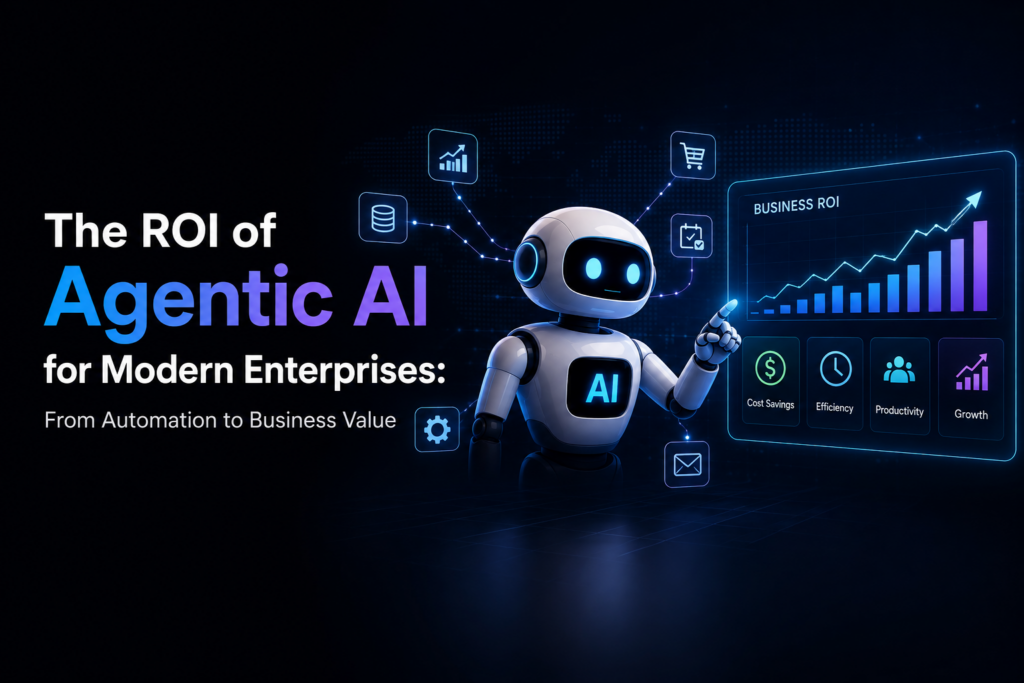

For years, enterprise AI was measured by how well a system could predict, recommend, or generate. Agentic AI changes the business question. The real test is whether an AI system can complete useful work across business processes and create measurable financial value. This is why the ROI of Agentic AI deserves a different framework from traditional software ROI.
Deloitte’s 2025 India research found that more than 80% of Indian organisations were exploring autonomous agents, while 70% showed strong interest in using GenAI for automation. Adoption is moving quickly. However, investment alone does not guarantee AI business ROI.
The value comes from choosing the right workflows, setting measurable targets, and designing agents around real business constraints.
Where Agentic AI Benefits Become Financial
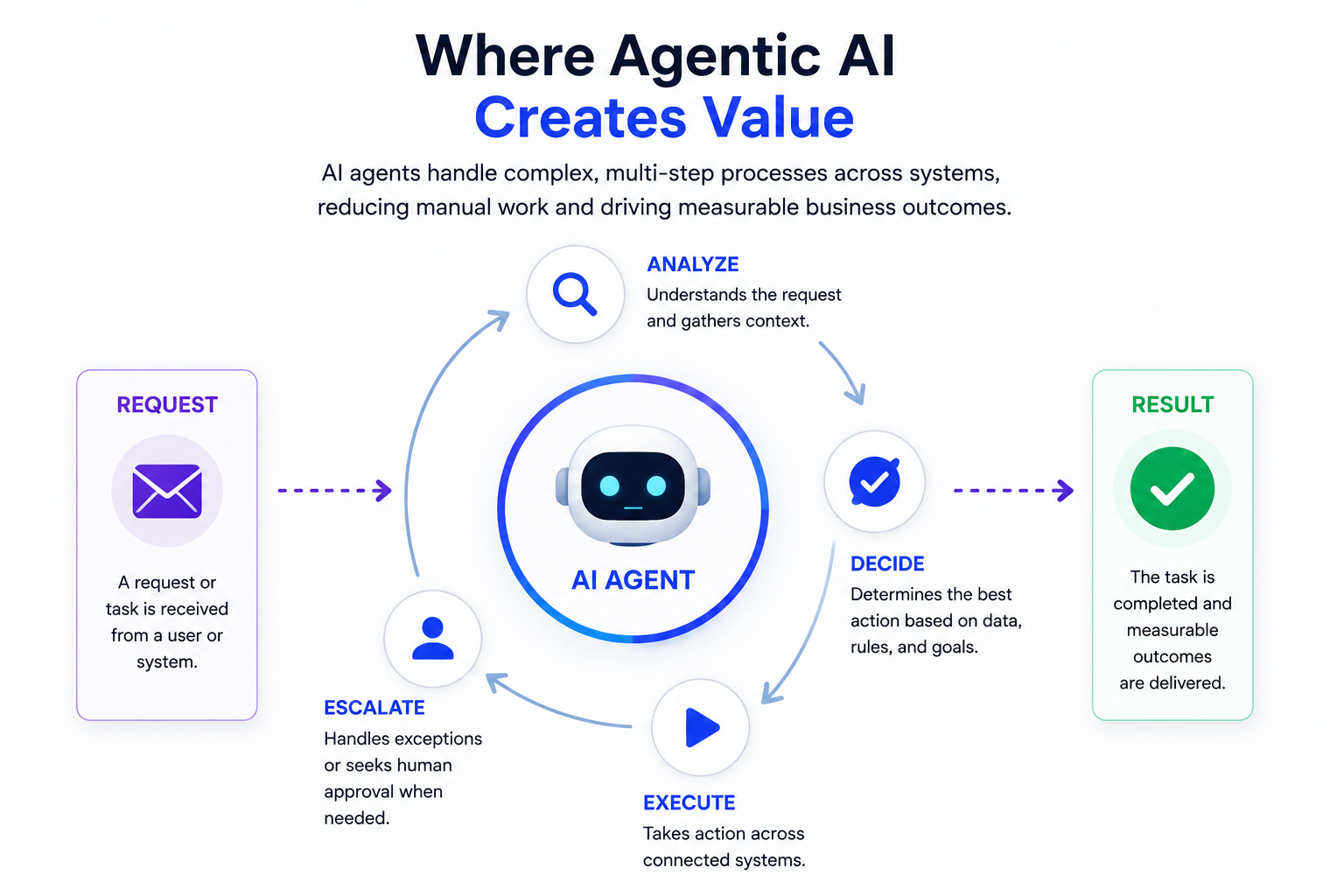
The strongest agentic AI benefits often appear in processes that involve repeated decisions, multiple systems, and high volumes of digital work. Consider a procurement workflow. An employee may review an email, check inventory, compare supplier data, validate pricing, update an ERP system, and send a response. Traditional automation can handle fixed steps. An AI agent can interpret the request, decide what action is needed, use connected systems, and escalate exceptions. That difference matters.
An enterprise AI agent can reduce the number of manual handoffs in a process. It can also shorten cycle times without requiring every step to be scripted in advance. This creates several measurable sources of ROI:
- Lower cost per transaction
- Fewer manual hours spent on repetitive work
- Faster response and processing times
- Higher employee capacity without matching headcount growth
- Lower error and rework costs
- Better use of specialist employees
- Faster customer and supplier response
The important point is that these benefits should be measured at the workflow level, not through vague claims about productivity.
Measure the ROI of Agentic AI Per Workflow
A common mistake is to calculate ROI from the total AI budget. That hides where value is actually being created. A better approach is to establish a baseline for each target process. For example:
AI business ROI = (Annual measurable benefit − Annual AI cost) ÷ Annual AI cost × 100
The measurable advantage might show up as labor savings , lower processing expenses, higher throughput, quicker revenue capture, or maybe even the avoidance of losses. So, say an order management process costs $500,000 each year just in human work and related rework. If an agentic workflow reduces that cost by 25%, the potential annual benefit is $125,000. The business can then compare that figure with development, infrastructure, model usage, monitoring, and maintenance costs. This makes the ROI of Agentic AI a finance discussion rather than a technology discussion.
AI Workflow Automation Creates Value Beyond Headcount
One of the most common misconceptions about AI workflow automation is that its value is only about swapping employees. But in lots of enterprises, the stronger business case is capacity. An agent can prepare information, perform routine checks, update systems, and handle standard requests while employees manage exceptions and higher-value decisions. The organisation therefore gets more output from the same team. This can be especially useful in finance operations, customer service, sales operations, HR, procurement, IT support, and compliance.
Deloitte notes that AI agents can extend automation into complex and dynamic processes that traditional automation struggles to manage. The financial impact can therefore come from process capacity, rather than direct staff reduction.
Enterprise AI Agents Need an ROI Gate
Not every process deserves an agent. A good enterprise use case usually has four characteristics:
- High transaction volume
- Repetitive but variable decisions
- Clear business rules and available data
- A measurable cost, revenue, or service outcome
Processes with low volume, unclear ownership, poor data, or high consequences from uncontrolled actions may produce weak returns. This is where governance becomes part of the ROI calculation. IBM’s 2025 CEO research found that only 25% of AI initiatives had delivered their expected ROI, while only 16% had scaled across the enterprise. The lesson is important: proving an AI concept is very different from creating an economically sustainable system.
The Hidden Cost of Poor Agent Design
An AI agent may look inexpensive during a pilot. Production economics are different. Enterprises need to account for model usage, API calls, integration work, monitoring, security, human review, exception handling, data preparation, and ongoing optimisation. Agentic systems can also create new risks if they are given broad access without proper controls. Therefore, the ROI of Agentic AI should include both value created and value protected.
A well designed agent has to, really clear permissions set and defined escalation rules, plus audit trails. And there should also be human oversight for the sensitive kind of decisions. With those guardrails in place, it can stop costly mistakes while still letting automation take care of the routine tasks, more or less.
Build for Compounding Enterprise Value
The strongest agentic AI benefits may appear after the first workflow. Once an organisation has secure integrations, reusable tools, governance controls, evaluation methods, and reliable data pipelines, those capabilities can support additional agents. This creates a compounding effect.
The second workflow may require less integration effort than the first. The third can reuse monitoring and governance components. Over time, enterprise AI agents become part of a broader operating model rather than isolated experiments.
Deloitte’s research shows that AI ROI can take longer than many technology investments, with most surveyed organisations reporting satisfactory ROI on typical AI use cases within two to four years. This makes disciplined scaling more important than chasing quick demonstrations.
The Business Case for Agentic AI Is Becoming Clearer
The ROI of Agentic AI is not about deploying the largest number of agents. It is about giving autonomous systems the right work, the right data, and the right boundaries. Businesses should begin with workflows where value can be measured before and after deployment. Track cost per transaction, turnaround time, error rates, employee capacity, customer response time, and revenue impact. Then scale what proves its value.
For organisations moving from AI experiments to production systems, Agentic AI Development Services can help connect agents with existing enterprise applications, build workflow logic, establish controls, and design systems around measurable business outcomes.
As agentic technology matures, the competitive advantage will belong to enterprises that can connect AI capability with operating economics. The question is no longer whether an AI agent can perform a task. It is whether that task is worth automating, how much value it creates, and how reliably that value can scale.