
There are a number of things that have changed with the coming of online grocery shopping. Today’s customers are keen to shop for their groceries via mobile applications because they will have the chance to search for numerous products, compare prices, arrange for delivery timings, and choose the point of delivery. The grocery stores will get a chance to make the process easy and interact with the consumers.
An ideal grocery application would link the consumers, store, delivery boys, and administrators within a single virtual world. Starting from searching for products and placing orders to payments and delivery tracking would all take place virtually.
Companies wanting to make entry into this developing market will be able to partner with a good grocery delivery app development company that can design an application as per their business model and requirements.
What is the Grocery Delivery App?
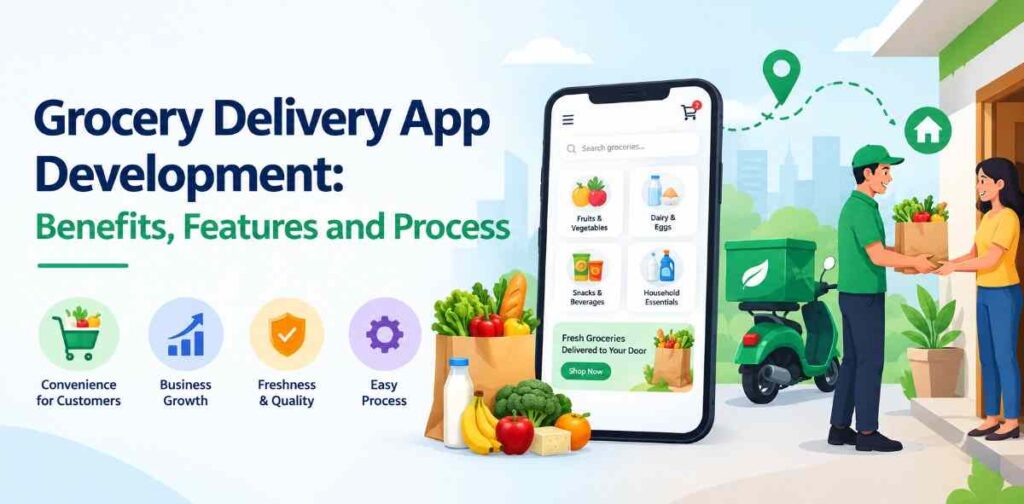
Grocery delivery applications are those mobile apps which allow the customers to purchase groceries and other things through an online platform and get the products delivered to desired destinations. The app normally integrates all stakeholders involved in the process, that is, the customers, the grocery stores, suppliers, the delivery service providers, and the administration.
The on-demand grocery delivery application has several different interfaces. The customers are able to look for products, add things to the shopping cart, choose delivery timeslots, pay, and monitor their orders. The store owners have the ability to manage the products, inventory, prices, and orders; the delivery partners may accept assignments and drive to the customer’s address.
Apart from helping out customers in doing transactions, grocery apps also provide important information to businesses. Information such as order information, popular products, customer behavior, inventory control, and effective deliveries can help businesses make their decisions.
Benefits of Grocery Delivery App Development
1. Convenient Shopping Experience
The consumers do not have to visit the store because all they need is a phone to order through the grocery app. The consumers will get to choose the category of products and the products they would like to purchase, add the products to their shopping cart and then place the order using their smartphone.
Features such as saved addresses, past orders, wish lists, and recommendations will make the ordering process very easy.
2. Wider Customer Reach
With a digital platform, grocery firms can access customers who may be outside the proximity of the physical store. This will depend on the delivery capabilities of the firm and can cover multiple neighborhoods and cities.
3. Improved Order Management
Manual order processing can become difficult as order volumes increase. A centralized application can automatically organize customer orders and provide businesses with a structured system for processing them.
Store administrators can monitor new, confirmed, prepared, dispatched, and delivered orders from a centralized dashboard.
4. Better Customer Engagement
The communication via mobile applications can be done in order to interact directly with the customers. The push messages can consist of orders updates, shipping notifications, promotions, and recommendations of the products.
The loyalty programs for the customers, promotions, and ordering of the products are some other ways through which customers can be brought back to the application.
5. Data-Driven Business Decisions
The grocery platform is capable of providing valuable information related to the purchase behavior, demand for products, order frequencies, and customer preferences.
The companies can use this information to optimize the inventory management, identify popular products, make promotions, and learn about customer demands.
6. Streamlined Delivery Operations
A connected delivery system can be helpful for business companies to manage deliveries by assigning delivery tasks and keeping customers updated.
GPS and route management can be helpful for delivery staff in finding the best route for delivery from store to customers.
Features of Grocery Delivery App Development
A successful grocery application requires features for different users rather than focusing only on the customer interface.
Customer App Features
- User Registration and Login: Users will have the option to log in to accounts via email, phone number, or social authentication mechanisms.
- Product Search and Filters: The search feature makes it easier for users to locate a specific product, while filters can categorize them based on various factors.
- Product Catalog: Businesses can showcase the names, images, descriptions, prices, offers, sizes and availability of the products.
- Shopping Cart: The order page allows customers to view predefined products, change their quantity, delete them, and view the total order amount.
- Multiple Payment Options: Users can also pay using cards, e-wallets, bank payments, or any other medium supported by the payment gateway.
- Order Tracking: Customers can follow the stages of order processing, from confirmation to preparation, departure, and delivery.
- Ratings and Reviews: Users can easily publish their reviews and rate products, shops and delivery services.
Admin Panel Features
The administration panel provides businesses with centralized control over the platform.
Important capabilities can include:
- Customer management
- Product and category management
- Inventory management
- Order management
- Delivery partner management
- Payment monitoring
- Coupon and promotion management
- Sales reports
- Customer analytics
- Notification management
Delivery Partner Features
Delivery personnel require a dedicated interface to manage assigned deliveries.
Important features include:
- Delivery partner registration
- Order assignment
- Order status updates
- GPS navigation
- Customer contact options
- Delivery history
- Earnings information
- Availability status
- Proof of delivery
AI-Powered Features
AI could also help in adding another level of intelligence to the grocery platform. Companies can take advantage of AI development services to have abilities like product recommendation, intelligent search, prediction, customer service chatbots, and product suggestion.
A recommendation engine built using AI technology would help in suggesting the right products based on the previous purchase and browsing history of users. Businesses could also predict the demand for groceries based on predictive analysis.
Prominent Business Models of Grocery Mobile Apps
The selection of a proper business model is another crucial element in building a grocery app. There are different types of models that can be chosen based on company resources and target audience.
1. Inventory-Based Model
In this case, the business will either own the stock or manage it and sell products directly to consumers using the app.
This will be under control of the firm when it comes to product availability, prices, packaging, and delivery services.
2. Marketplace Model
The customers can pay a recurring payment via the subscription model in return for benefits such as free delivery, discount offers, express delivery, or any other benefit.
This will ensure a continuous income stream for the company, along with encouraging the users to use the app.
3. Hyperlocal Delivery Model
The hyperlocal model links customers to grocery stores in their immediate vicinity and ensures that orders are delivered in a particular geographic area.
The Hyperlocal Model can be especially useful for companies focusing on one particular city, neighborhood, or market where speedy delivery is an important factor for customers.
4. Subscription-Based Model
Customers will be required to pay for subscriptions and in return receive various perks including free delivery, unique discounts, priority deliveries, etc.
The main advantage for businesses is that subscriptions guarantee a continuous revenue stream and prompt order placement.
How to Build a Grocery Delivery App Step by Step
When you develop a grocery delivery app, it involves multiple stages, from business planning to deployment and ongoing optimization.
1. Define the Business Requirements
Begin by analyzing your target customers, market geography, products, marketing, and business objectives.
This is where you find out if the app will be a marketplace app, an inventory app, or another form of an app.
2. Conduct Market and Competitor Research
Review existing grocery apps to determine their characteristics, customer experience, pricing structure, delivery process, and market positioning.
These will help in determining what customers expect from an app like this.
3. Select the Core Features
Produce a list of features for customers, administrators, stores, and deliveries. Begin with the basics like registration, product searching, managing a shopping cart, and checkout, among others. The advanced features may come in subsequent stages of development.
4. Design the UI/UX
Developing wireframes and prototypes before actual development is necessary.
The UI must make key functions accessible to users. Users should be able to look up products, browse through categories, add products to cart, and checkout without difficulty.
5. Choose the Technology Stack
Choose technologies depending on the application’s functionality needs, scalability needs, development budget, and number of users.
The technology stack must be able to accommodate secure transactions, API integration, database management, cloud computing, and third-party integrations.
6. Develop the Application
The process of development involves the creation of interfaces, backend services, APIs, database systems, payment processing, authentication systems, notification systems, delivery tracking, and administration systems.
Organizations can work with a service provider that offers the development of grocery delivery apps.
7. Integrate Third-Party Services
Integrations such as payment gateways, mapping, GPS tracking, push notifications, SMS validation, analytics, etc. can be required by a grocery app.
These integrations require thorough testing for ensuring that there is proper communication between the app and the third-party software.
8. Test the Application
Comprehensive testing should cover functionality, performance, security, compatibility, usability, and payment workflows.
Testing should also consider different devices, operating systems, network conditions, order volumes, and user scenarios.
9. Deploy the App
Once tested and proven, the application can then be deployed through appropriate app stores and cloud infrastructure. Prior to the store submission, analytics, monitoring, security controls, backup and administrative access can be set up.
10. Maintain and Improve the Platform
The app development does not stop after the launch. You need frequent updates with bug fixes, performance improvements, new features, additional security measures, and other customer-driven feedback. Analyzing customers’ feedback and observations can help your company target the areas where the application experience can be optimized.
Tech Stack for On-Demand Grocery Delivery App Development
The technology stack should be selected according to the application’s requirements, scalability, security needs, and expected traffic.
| Development Area | Recommended Technologies |
| Mobile App | Flutter, React Native, Kotlin, Swift |
| Frontend | React.js, Next.js, HTML, CSS, JavaScript |
| Backend | Node.js, Python, Java, PHP |
| Database | PostgreSQL, MySQL, MongoDB |
| APIs | REST API, GraphQL |
| Cloud | AWS, Microsoft Azure, Google Cloud |
| Authentication | OAuth, Firebase Authentication, JWT |
| Payments | Stripe, PayPal, Razorpay |
| Maps & Location | Google Maps Platform, Mapbox |
Scalability allows for the inclusion of other functionalities within the platform as the organization grows. Businesses can start off with basic functions, such as buying and fulfillment, and then proceed to introduce more sophisticated functionalities like recommendations, inventory management, analytics, and support systems.
Grocery delivery app development services often require tailored technical solutions aligned with specific operational needs. Selecting a dedicated technology stack allows businesses to fulfill unique requirements rather than relying on standard frameworks.
Conclusion
In the digital world, the grocery delivery apps link the needs of customers and retail organizations in a daily routine. Thanks to this platform, you will be able to simplify the process of ordering, boost delivery coordination, increase engagement, and gain valuable operational insights for your business.
Each step in the development process is aimed at the improvement of the performance of the application as a whole—from business model definition and UX design to technology choice, payment and location integration, and testing.
With the dedicated development team and using the unique and latest AI-powered technology partner, businesses can build a scalable grocery platform that supports customer expectations while providing flexibility for future improvements. Helpful
Insight, a leading mobile app development company, can also integrate advanced capabilities such as AI-powered recommendations, predictive analytics, and intelligent automation as the platform evolves.