
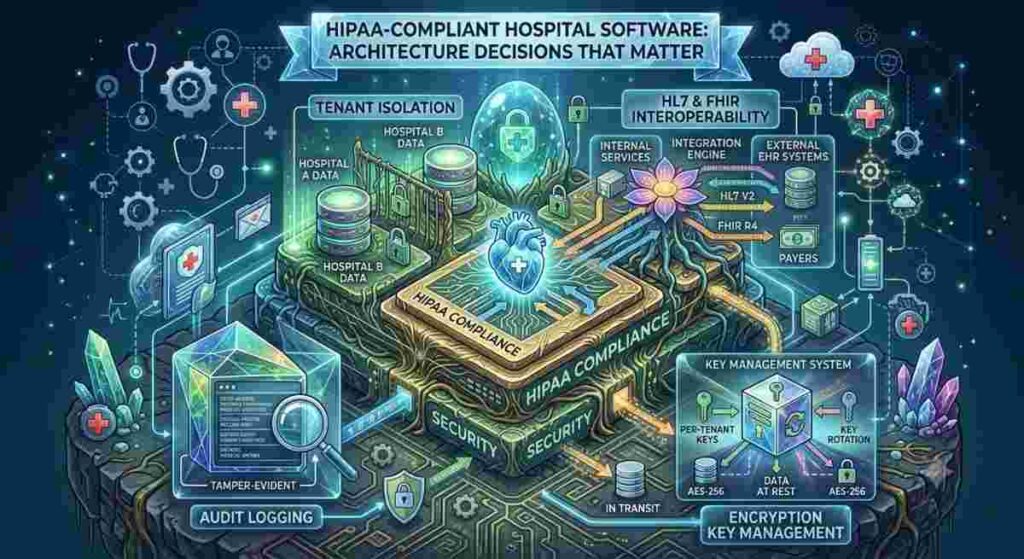

Most articles about hospital management software read like feature checklists: patient records here, billing there, a pharmacy module bolted on the side. What they skip is the part that determines whether the system survives contact with a real hospital IT department, a real HIPAA audit, and a real EHR vendor’s integration team. This piece is about that part – the architecture decisions that show up in the first design review and keep showing up eighteen months later, usually at the worst possible time.
The following is drawn from building hospital management platforms in production, not from a vendor datasheet. Four decisions tend to define the rest of the build: tenancy and data isolation, HL7/FHIR interoperability, where compliance work actually consumes engineering time, and the encryption model that ties it all together.
Single-Tenant vs. Multi-Tenant: The Isolation Decision That Shapes Everything
Why multi-tenant looks easier on paper
A shared multi-tenant database is the default instinct for almost every SaaS team. One schema, one set of migrations, one deployment pipeline, and a tenant_id column doing the separating. It is cheaper to run, faster to ship, and easier to scale horizontally. For a project management tool, that is usually the right call.
Where it breaks down for hospital data
Hospital management software is not a project management tool. A shared schema means a single missed WHERE clause, a single ORM bug, or a single misconfigured row-level security policy can expose one hospital’s patient records to another tenant’s application context. Under HIPAA, that is not a bug ticket – it is a reportable breach with mandatory notification obligations, and the Office for Civil Rights does not care that the root cause was an off-by-one in a query builder.
Hospital IT departments know this, and their security questionnaires reflect it. “Describe your tenant isolation model” is one of the first questions in almost every enterprise healthcare procurement review, and “logical separation via a tenant_id” is rarely a satisfying answer once a security reviewer starts asking follow-up questions about backup restoration, disaster recovery, and cross-tenant query auditing.
A middle path that actually holds up
In production, the pattern that balances cost against isolation is pooled infrastructure with hard schema-level or database-level separation per tenant: shared compute, shared application code, but each hospital’s data lives in its own PostgreSQL schema or its own database instance, provisioned automatically at onboarding. This keeps operational overhead close to multi-tenant levels while giving each tenant a genuine isolation boundary that a security reviewer, and an auditor, can actually point to. It also makes per-tenant encryption keys and per-tenant backup/restore straightforward, which matters more than it sounds like it should when a hospital’s compliance officer asks for proof of data segregation during a vendor audit.
The trade-off is migrations. Every schema change now runs across N schemas instead of one, and that discipline has to be built into the deployment pipeline from day one, not retrofitted after the fifteenth hospital signs on.
HL7/FHIR Interoperability: The Reality Behind the Buzzword
HL7 v2 is still the incumbent, whether anyone likes it or not
Every RFP mentions FHIR. Every legacy hospital EHR still speaks HL7 v2 for the workflows that actually move data day to day: ADT (admit-discharge-transfer) feeds, lab result messages, and order entry. Epic, Cerner (now Oracle Health), MEDITECH, and the dozens of smaller regional EHR platforms all support FHIR to varying degrees, but the ADT feed that tells your system a patient was just admitted is, more often than not, still an HL7 v2 pipe-delimited message arriving over an MLLP connection that was configured a decade ago and that nobody on the hospital’s side fully remembers the details of.
Building only a FHIR client and assuming the hospital’s EHR will meet you there is a common first-year mistake. Budget for an HL7 v2 listener and parser as a first-class citizen of the architecture, not an afterthought bolted on after the FHIR layer is already built.
FHIR adoption is real but uneven
Where FHIR does help is in newer, more structured exchanges: patient demographics, care summaries, and increasingly, the interfaces mandated by information-blocking and interoperability rules in the U.S. But FHIR R4 implementations vary meaningfully between vendors in which resources they expose, which extensions they require, and how strictly they validate against the base specification versus a vendor-specific profile. Treat each hospital’s EHR integration as its own project with its own validation pass, even when both source and target claim FHIR R4 compliance.
Build an integration engine, not a point-to-point sync
The architecture pattern that scales past the second or third hospital integration is a dedicated integration engine sitting between your core platform and the outside world – normalizing inbound HL7 v2 and FHIR messages into your internal data model, queuing them for reliable processing, and exposing a consistent internal API to the rest of the system. Point-to-point mappings between your database schema and each EHR’s message format work for a pilot. They become unmaintainable by the fourth or fifth hospital, each with its own quirks, missing fields, and non-standard segments.
Where Teams Actually Lose Time on HIPAA Compliance
HIPAA compliance is often treated as a checkbox exercise late in the build. In production, three areas consistently eat far more engineering time than teams budget for.
Audit logging that is actually usable during an investigation
Writing log lines is easy. Building audit logging that satisfies the HIPAA Security Rule’s requirement to track who accessed what patient record, when, and why – and that can answer a compliance officer’s question in minutes rather than requiring someone to grep through application logs – is a different problem. The logging needs to be append-only, tamper-evident, queryable by patient, by user, and by time range, and retained for the periods required by both HIPAA and applicable state law. Teams that treat this as a database table with a few extra columns usually end up rebuilding it once the first real audit request lands on their desk.
Access control layers that match clinical reality
Simple role-based access control (a doctor role, a nurse role, an admin role) breaks down fast in a hospital setting, because access needs often depend on context: is this clinician currently assigned to this patient’s care team, is this a break-glass emergency access situation, has this patient requested a restriction on who can view certain records. Attribute-based access control, layered on top of a baseline RBAC model, is what production systems actually need – and it needs to be designed early, because retrofitting contextual access rules onto a system built with flat roles is a significant rewrite, not a patch.
Encryption at rest vs. in transit: different problems, different decisions
Encryption in transit is close to a solved problem: enforce TLS 1.2 or higher everywhere, including internal service-to-service traffic, not just the public-facing edge. Encryption at rest is where the real decisions live. AES-256 at the storage layer is table stakes, but the harder question is key management: per-tenant keys versus a shared key, where keys are stored (a managed KMS versus a self-hosted HSM), and how key rotation is handled without downtime. For hospital clients handling their own compliance obligations, being able to say “each hospital’s data is encrypted with a key that hospital’s data alone uses” is often the deciding factor in a procurement review, well before feature comparisons come into play.
System Architecture: Putting the Pieces Together
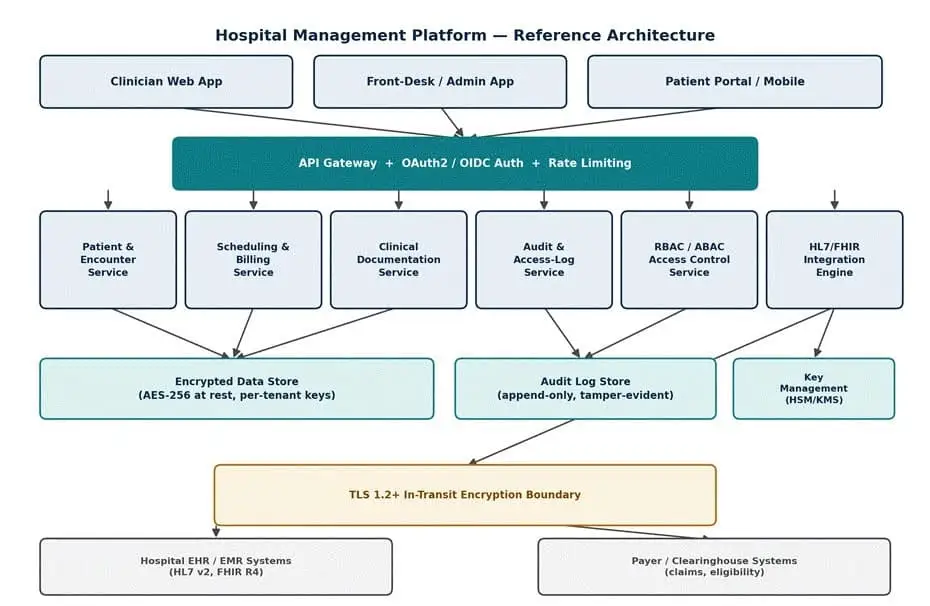
The diagram below reflects the pattern described above in practice: client applications talking through a single API gateway that handles authentication and rate limiting, a set of focused services including a dedicated audit service and access control service, a data layer with per-tenant encryption and a separate tamper-evident audit store, and an HL7/FHIR integration engine sitting at the boundary with external EHR and payer systems.
Real Trade-offs from Production
A few concrete trade-offs that only became visible after systems were running with real hospital data, rather than during initial design:
- Schema-per-tenant isolation simplified security reviews but meant a single slow migration script could lock out multiple hospitals simultaneously during a deployment window – this pushed the team toward staggered, tenant-batched migrations rather than a single global rollout.
- Building the HL7 v2 listener before the FHIR client, not after, cut integration time with legacy EHRs roughly in half, because most early-stage hospital pilots turned out to depend on ADT feeds that had no FHIR equivalent available on the hospital’s side.
- Treating audit logs as an operational data store, not just a compliance artifact, meant compliance officers could self-serve investigation queries instead of filing a request and waiting on engineering – this reduced the support burden more than any other single compliance decision.
- Attribute-based access control added real complexity to the permission model, but retrofitting it after launch – which one hospital client’s growing multi-site rollout eventually forced – took roughly three times longer than building it in from the start would have.
None of these decisions are exotic. They are the ordinary trade-offs of building software that has to satisfy a hospital’s compliance officer, a security reviewer, and a clinical staff member trying to admit a patient at 2 a.m., all at once. Getting the architecture right early is less about anticipating every future requirement and more about choosing patterns – tenant isolation, an integration engine instead of point-to-point mappings, audit logging as a first-class service – that absorb new requirements without a rewrite.
Teams evaluating whether to build this layer in-house or bring in a specialized partner for the compliance and interoperability work often start by comparing notes with a team that has already shipped a hospital management software development project through a real HIPAA compliance review, rather than starting the architecture conversation from a blank page.
The architecture decisions covered here – tenancy, interoperability, audit logging, and access control – are the ones that are expensive to get wrong and expensive to change later. They are worth the extra design-review time before the first line of code is written.