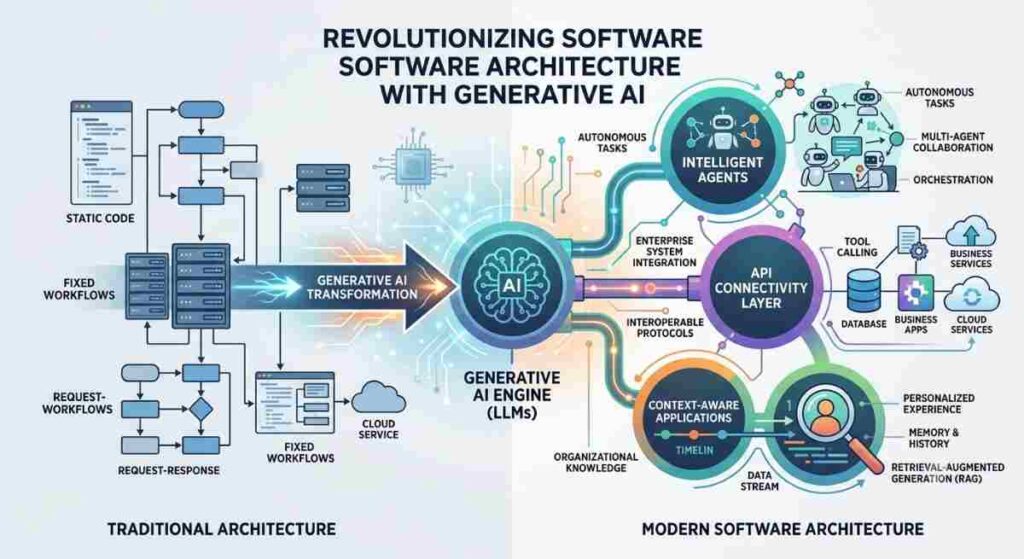

Generative AI is revolutionising the traditional architecture of software systems that were based on fixed workflows by enabling more adaptable and intelligent application environments. In addition to being utilised as a tool for generating content, the adoption of generative AI is now driving the way modern software is architected, designed, integrated, and used.
This process encourages developers and companies to think differently about traditional architecture practices and explore new ways for integrating intelligence into their software. Intelligent agents, API’s, and context-aware applications are some of the components that have started playing an important role in this process of architectural change and are offering companies a new way of integrating AI capabilities into their software architecture.
The emergence of these new trends is impacting the generative AI market solutions since companies are looking to integrate AI capabilities into their technological and application environments.
Agents Are Becoming Part of Software Architecture Core
The development of generative AI allows taking software architecture beyond applications that merely react to predetermined instructions. Intelligent agents are now a key architectural element as they introduce more independence in the way software executes tasks, workflows, and interactions.
Instead of needing all steps to be defined in advance, an agent-based approach will allow designing applications that decide on their own how the various activities should be done. It allows shifting the function of software from the execution of pre-defined functions to a flexible environment where AI functions can be embedded.
- Intelligent Agents Making Applications Autonomous Systems: Intelligent agents are helping applications transition from their traditional request-response interaction model to a better version. They can serve as a smart interface that lies between the user and the software functions and thus enable applications to have complex task execution capabilities. This becomes especially important when there are many tasks in the workflow, and the software application needs the user to interact with many different functions. The inclusion of agent capabilities in applications allows for the creation of systems based on goals and objectives rather than actions.
- Multi-Agent Architectures Facilitating Collaborative Work Processes: Multi-agent architectures go a step further by incorporating specialised agents in the same application domain, each serving a certain purpose. Instead of having all tasks performed by one artificial intelligence agent, the software can incorporate the use of specialised agents that will perform different tasks. There is an agent that can deal with the information processing, another that will take care of the planning process, and others performing other operations. These specialised abilities can then be incorporated as part of a collaborative process.
- Agent Orchestration Bridging Models, Tools, and Applications: The orchestration of agents is an architectural feature that enables the integration of the various types of AI technologies into an application architecture. It defines how the agents work with available models, functionalities, and other software tools. This allows the developers to design workflows that enable various AI technologies to contribute to a common application. Agent orchestration helps provide more coordinated integration among various elements, making it possible for applications to handle complex processes more easily. As a result, agent orchestration is emerging as an important architectural tool for leveraging generative AI technologies in software development.
APIs Drive the Connectivity Layer of Generative AI
The development of Generative AI technologies has resulted in the evolution of API usage, not only for communication between software programs but also as the connectivity layer for AI technology. APIs make it possible for AI functionalities to connect with business systems, databases, and applications without having to modify these systems to meet the demands of AI.
They have become very important in terms of architecture and serve as an essential link between the generative AI technologies and software.
- API Driven Integration of Models and Enterprise Systems: APIs offer standard mechanisms that can be leveraged to integrate generative AI models with enterprise applications and enterprise software stacks. These mechanisms enable developers to add capabilities of artificial intelligence into client systems, productivity applications, database systems and operations systems. In this way, organisations can build on top of their technology stack and integrate additional features. Rather than having to design separate solutions for each use case of artificial intelligence, developers can integrate models with already existing services and capabilities.
- Tool Calling – Linking Agents to Business Applications: Tool calling is another step that further enhances the usefulness of APIs through the ability of AI systems to work with certain software functionality. The application will be able to provide a list of tools that can be accessed via a defined interface, through which the AI system will be able to call a particular operation or obtain some piece of information. The application will perform the required function and return the output that can be used for further processing. In this way, a practical link is established between the AI system and the operational software.
- Interoperable Protocols for Connective AI Ecosystems: Interoperability is becoming more relevant now than ever before with multiple models, agents, applications and tools used by organisations. Standardised interfaces and protocols can facilitate communication between the different elements without requiring separate customisations. Reusable connections would be facilitated by interoperable architectures, and software engineers would be able to scale the AI functionalities based on the evolving needs of the applications. Interoperable architectures could help organisations to integrate their internal systems with external offerings while keeping clearer distinctions between the different elements.
Context-Aware Applications Redefine User Interactions
Context-aware applications have brought a different paradigm to interacting with software, where the system takes into account the context in which each user interaction takes place. This way, the application can utilise information that is relevant to the current session, past interactions, user preferences, the current conditions and knowledge.
This means that there is continuity of user interaction with software. Context is thus an important design factor for applications based on generative artificial intelligence. It affects not only the way information is presented but also the interactions and adaptation of software depending on changing needs. The transition is especially important in the applications where the relevance of the AI answer depends on the context in which the request is made.
- Memory and Context Enabling Personalised Applications: Memory allows applications to maintain continuity across interactions and build a more consistent understanding of users and their activities. Instead of repeatedly starting with limited information, an application can retain relevant preferences, previous interactions, goals, or task history and use them when appropriate. This creates opportunities for more personalised software experiences across areas such as productivity, customer engagement, education, and digital assistance. Memory can also support continuity within longer workflows, allowing applications to preserve important information as users move between different stages of a task. As a result, personalisation becomes an architectural capability rather than simply a feature added to the user interface.
- Retrieval-Augmented Generation-Connecting AI with Enterprise Knowledge: Retrieval-augmented generation provides applications with a mechanism for incorporating relevant information from organisational knowledge sources into generative AI experiences. Rather than being limited to information contained within the model, applications can access relevant information in documents, databases, knowledge bases, or any source of information while creating the output. This technique becomes very useful for enterprise applications since the information required may be specific to the organisation, continuously changing, or large enough to not be included in the model. In this way, by tying together generation and accessible knowledge, the application becomes able to generate experiences relevant to the information requirements of the users.
- Real-Time Context Supporting Adaptive Software Experiences: Real-time context extends contextual intelligence beyond stored information by incorporating changing conditions into software interactions. Applications can consider current activity, workflow status, newly available information, or other relevant environmental signals when determining what information to present or how an interaction should proceed. This makes software experiences more responsive to circumstances rather than fixed to predetermined interaction paths. Context-aware design can therefore support applications that adjust naturally as situations change, creating more dynamic user experiences. The combination of persistent information, retrieved knowledge, and current conditions establishes a foundation for software that can respond according to the broader situation surrounding each interaction.
The Use of Generative AI in Software Design and Development is a Major Shift
The use of generative AI has led to a shift in the way software is designed and developed. The use of generative AI has made it necessary for architects to think about intelligence from the outset when designing a software program. By doing so, it becomes necessary to think about how the intelligence should be integrated into the software program, what kinds of operations require dynamic intelligent behaviour, and what types of operations need to stay with the traditional programmed behaviour.
Moreover, generative AI is shaping development teams’ perception of the software development lifecycle. The process of AI-enabled development could be used to implement requirements into ideas, explore alternative software structure possibilities, develop documentation, and improve existing software building blocks. This would let developers focus on system-level decision-making, user requirements, and overall application design.
In this case, the development process may become iterative in nature, as development teams are going to keep improving software structures according to changing business conditions and available technology. Generative AI, thus, should be perceived not as a replacement for the existing development approaches but rather as a new design or development capability.
Next Phase of Software Enabled by AI
AI-driven software is transforming the way software architectures are built as new paradigms are emerging for building application intelligence, connectivity, personalisation, and software development. With intelligent agents, APIs, and context awareness becoming more prevalent, software architectures are becoming more adaptive and connected.
As companies keep pursuing such strategies, the generative AI market is enabling greater adoption of AI-powered applications in various digital ecosystems. According to Pristine Market Insights, it represents an emerging technology landscape where AI is embedded into software architectures. Such a shift also motivates software developers to reconsider traditional architectural approaches and build in intelligence from the early stages of designing software.