
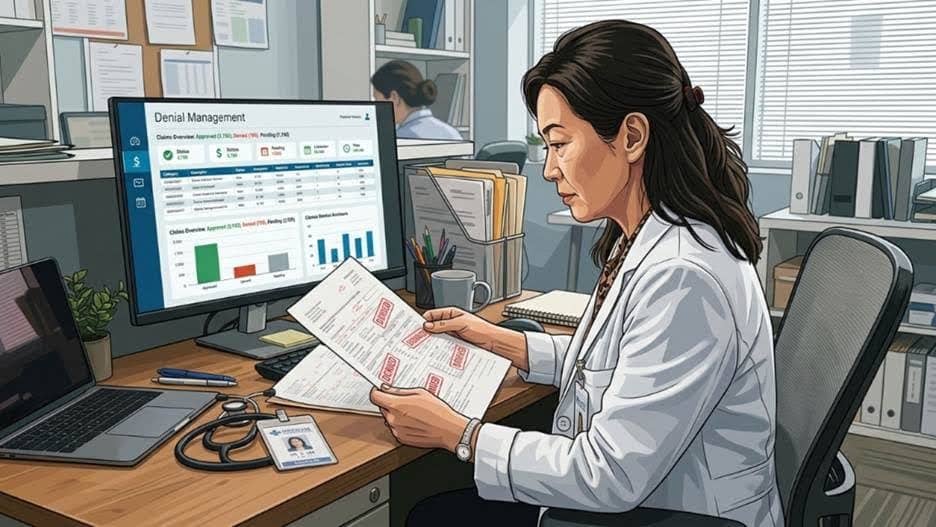

Ask any dermatology office manager what eats up the most staff time, and billing headaches usually top the list. Claims go out, some bounce back, someone has to figure out why, fix it, and resend it. Multiply that by dozens of patients a week, and it becomes a full-time job on its own. Medical billing automation exists to break this cycle, catching problems before a claim ever leaves the building instead of after a payer rejects it.
Below, we will look at why denials happen so often in this speciality, what a smarter denial management process actually looks like, where automation fits into the picture, and how practices can turn all of this into a lasting habit rather than a one-time fix.
Why Dermatology Billing Is Harder Than It Looks
On the surface, billing seems like a paperwork task. In practice, dermatology adds real complexity. A single visit might involve a mix of medically necessary and cosmetic procedures, each with different documentation standards. Coding has to reflect that distinction precisely, or a payer will reject the claim outright.
Add in constantly shifting payer rules, and it is easy to see why even seasoned staff occasionally miss something. A procedure that was covered last time might require different documentation this time, simply because a payer updated its internal policy without much notice. Staff cannot always keep pace with every change across every payer, especially in a busy practice.
Medical billing automation helps here by taking over the repetitive checking, confirming that codes, documentation, and patient details all line up before submission rather than relying on someone catching it manually. It does not eliminate the need for skilled judgment, but it does remove a lot of the tedious cross checking that used to fall entirely on staff shoulders.
The Hidden Cost of Denials
A denied claim is not just an inconvenience. It means delƒayed payment, extra hours spent tracking down the issue, and sometimes a claim that never gets successfully resubmitted at all. Multiply a handful of these across a busy month and the financial impact adds up fast.
What stings most is that so many medical billing denials trace back to something small. A missing signature. An outdated policy number. A code that does not quite match the note in the chart. None of these are complicated mistakes, but they are the kind that happen when staff are moving quickly through a high volume of claims.
There is also a quieter cost that does not show up on a spreadsheet right away. Staff morale tends to suffer when the same types of errors keep resurfacing without ever being fully resolved. People start to feel like they are constantly cleaning up after a broken process instead of doing meaningful work, and that kind of fatigue eventually shows up in the quality of everything else they touch.
What Good Claim Denial Management Actually Looks Like
Here is where a lot of practices go wrong. They treat denials as one off problems to solve individually instead of stepping back and asking why they keep happening. Real claim denial management means tracking patterns over time. Which procedures get denied most often? Which payers are stricter about documentation? Once you can answer those questions, you can fix the actual source of the problem instead of putting out the same fire every week.
This is also where consistency beats effort. A team working hard but reacting to each denial as it comes will always be behind. A team with a system for spotting trends gets ahead of them. Over time, the difference between these two approaches becomes obvious in the numbers, even if it is hard to see week to week.
Building this kind of visibility does not require anything exotic. Something as simple as a shared log of denial reasons, reviewed on a regular basis, can reveal patterns that would otherwise stay hidden in the noise of daily work.
What Usually Causes Denials in the First Place
Most rejected claims fall into a few familiar buckets. Documentation that does not fully support the procedure billed. Mismatched or outdated codes. Missing prior authorization. Eligibility that was never confirmed before the visit even happened.
None of these are exotic problems. They are the kind of everyday gaps that appear when staff are stretched across a heavy caseload. Procedures requiring extra clinical justification are especially vulnerable, since a thin note or an overlooked detail is often all it takes to trigger a rejection.
It is worth noting that these issues rarely happen because staff are careless. More often, they happen because the process itself has too many manual handoffs, and each handoff is a chance for something to slip. Some practices choose to bring in dedicated Dermatology Billing Services to work alongside their internal team, pairing specialized knowledge with the consistency that comes from having someone focused entirely on getting claims right the first time.
How to Reduce Claim Denials Without Overhauling Everything
If you are researching how to reduce claim denials, the good news is that most of the fix happens before a claim is ever filed. Confirming eligibility ahead of the appointment. Making sure notes actually support the codes being billed. Having a second set of eyes on anything unusually complex.
None of this requires reinventing your entire process. Small, consistent habits, like flagging high risk procedures for extra review or assigning someone to watch denial trends, tend to move the needle more than a sweeping overhaul ever does.
A lot of it also comes down to communication between departments. When clinical notes are clear and billing staff have what they need without having to chase it down, clean claims happen naturally instead of by accident. Practices that invest time in building this kind of communication often find that denials drop noticeably within a fairly short stretch, simply because fewer claims go out with gaps in the first place.
Where Automation Actually Moves the Needle
This is the part that surprises people. Automation is not about replacing billing staff, it is about giving them a system that catches what a tired set of eyes might miss late in a long day. Medical billing automation can flag a mismatched code, confirm documentation matches the claim, and check eligibility long before a human ever needs to intervene.
The value compounds over time too. Instead of every staff member developing their own shortcuts and habits, automation keeps the process consistent no matter who is handling a given claim. That consistency is often what separates a practice with occasional denials from one that deals with them constantly.
There is also a training benefit that gets overlooked. New staff members ramp up faster when the system itself is guiding them toward correct submissions, rather than expecting them to memorize every payer quirk from day one.
Turning This Into a Long Term Habit
None of this works as a one time fix. Reviewing which claims get denied, adjusting the process based on what you find, and keeping staff trained on why it matters all have to happen continuously. Practices that treat this as an ongoing habit rather than a project with an end date are the ones that actually see denial rates drop and stay down.
Good data helps too. Automation naturally generates a clearer picture of what is going wrong and how often, which takes the guesswork out of deciding what to fix next. Pairing that data with regular check ins among staff keeps everyone aligned on what needs attention, instead of letting old habits quietly creep back in.
Conclusion
There is no single switch that eliminates claim denials overnight. What actually works is a steady, well supported process, and medical billing automation gives dermatology practices a real way to build one. It catches errors early, cuts down on repetitive manual work, and helps create a revenue cycle that does not feel like a constant scramble.
Pair that kind of automation with solid internal habits and a team that understands why the details matter, and denial rates tend to fall on their own. If your practice is ready to take a closer look at where automation could help most, now is a good time to start.