
Healthcare is one of the last practical guides to medicine delivery app development, covering prescription workflows, inventory sync, healthcare compliance, and the mistakes teams make. t major industries to go fully digital, and medicine delivery is at the centre of that shift. What used to mean a trip to the pharmacy, a queue, and a wait is now a matter of tapping a few buttons on a phone and getting medication at the door.
But building a medicine delivery app that actually works is harder than it looks. It sits at the intersection of healthcare regulation, logistics, real-time inventory, and user experience. Get any one of these wrong and the whole product breaks down. This article breaks down what it actually takes to build one that works well in the real world, from architecture decisions to the features that matter most.
Why Medicine Delivery Apps Are Different From Other On-Demand Apps
If you have built food delivery or grocery apps before, medicine delivery might feel familiar on the surface. Pickup, delivery, tracking. But there are layers of complexity here that do not exist in other on-demand verticals.
First, there is prescription verification. You cannot just let users upload an image of anything and ship them medication. The app needs a reliable workflow to validate prescriptions before fulfilling orders. This involves either manual pharmacist review, automated OCR-based checks, or a combination of both.
Second, there is the regulatory dimension. Medicine delivery apps are subject to healthcare laws that vary by country and region. In India, for example, the Drugs and Cosmetics Act governs online pharmacy operations. In the US, HIPAA compliance is non-negotiable for any app handling patient data. These are not optional add-ons. They are foundational to how your system is built.
Third, there is the inventory challenge. Medicine stock is highly time-sensitive. Expiry dates, storage conditions, controlled substances, and substitution rules all add complexity that a restaurant menu simply does not have.
Understanding these differences upfront shapes every technical and product decision you make downstream.
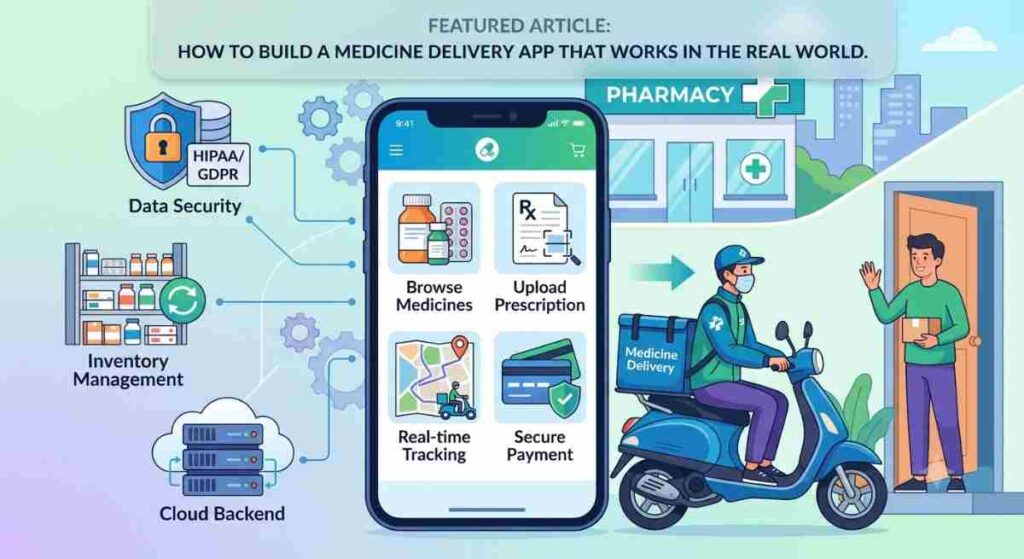
Core Features That a Medicine Delivery App Needs
There is a baseline set of features that any serious medicine delivery app must have. Getting these right is more important than loading up the app with extras.
Prescription Upload and Verification
This is the most critical workflow in the app. Users need a simple way to upload a prescription, either by camera or from their gallery. On the backend, a pharmacist or an automated system needs to review and approve it before the order moves forward.
The UX here matters enormously. If the verification step is confusing or slow, users will abandon the order. Design it to be clear, with status updates so the user knows what is happening at each stage.
Medicine Search with Smart Filters
Users should be able to search by name, generic name, or condition. Add filters for brand, dosage, and form (tablet, syrup, capsule). If a specific medicine is out of stock, automatically surface alternatives or similar substitutes so users do not hit a dead end.
Real-Time Inventory Sync
Your app needs to reflect actual pharmacy stock in real time. Nothing kills trust faster than placing an order and finding out hours later that the item is unavailable. Build proper inventory APIs that sync with pharmacy management systems and reflect live availability.
Order Tracking
Users ordering medication are often doing so because someone is unwell. They need to know exactly when the delivery is arriving. A live tracking screen with status updates at each stage — order confirmed, being packed, out for delivery, delivered reduces anxiety and supports queries.
Scheduled and Recurring Orders
Many users take medication regularly. A recurring order feature where they can set up monthly or weekly refills is a high-retention tool that food delivery apps rarely need but medicine apps genuinely benefit from.
Secure Health Profile
Let users store their health records, past prescriptions, and saved medications in a secure profile. This makes reordering fast and builds long-term engagement with the platform.
Architecture Overview
A production-ready medicine delivery app is really three systems working together: the user-facing app, the pharmacy/admin panel, and the delivery agent app.
User App
Handles search, prescription upload, order placement, payment, and tracking. Should be available on both iOS and Android. Flutter and React Native are both solid choices for cross-platform builds that keep the codebase manageable.
Pharmacy and Admin Panel
This is where prescriptions are reviewed, orders are confirmed, inventory is managed, and delivery is dispatched. It is typically a web dashboard built with React or Vue.js on the frontend and Node.js or Django on the backend.
Delivery Agent App
A lightweight mobile app that shows agents their delivery queue, route optimization, and order status. Integrates with Google Maps or a similar mapping API for real-time navigation.
For teams planning to build this end to end, partnering with a development company that has experience in on-demand healthcare apps makes a significant difference. AppDrives has built production-grade medicine delivery platforms that handle the full ecosystem from prescription verification to last-mile delivery. Their approach to medicine delivery app development covers both the technical architecture and regulatory considerations that teams often underestimate. You can see more at https://appdrives.com/medicine-delivery-app-development.
Data Security and Compliance
This section cannot be skimmed. Health data is among the most sensitive categories of personal information, and your infrastructure has to treat it that way.
Use end-to-end encryption for data in transit and at rest. Implement role-based access controls so only authorized users can view prescription data. Store health records in compliance with local regulations, and do not share user data with third parties without explicit consent.
If you are building for a US market, HIPAA compliance requires a Business Associate Agreement (BAA) with your cloud provider. AWS, Google Cloud, and Azure all offer HIPAA-compliant configurations, but you still have to set them up correctly. If you are building for the Indian market, familiarize yourself with the Digital Personal Data Protection Act and the guidelines issued by the Ministry of Health on online pharmacies.
Getting an external audit before launch is worth the investment. A security gap discovered post-launch is far more expensive than finding it before.
Payment Integration
Medicine purchases often involve insurance claims, co-payments, or HSA/FSA cards depending on the market. Build your payment layer to handle more than just standard credit card transactions.
For Indian markets, UPI integration is essential. For global audiences, Stripe or Braintree handle most use cases well. Whatever gateway you choose, make sure the checkout flow is fast and works smoothly on slower mobile connections, since many users in tier-2 and tier-3 markets will be on 4G with variable speeds.
Delivery Logistics
Last-mile delivery for medicine has different constraints than food. Medications often need careful handling. Some require refrigeration. Controlled substances need a signature on delivery. Build these requirements into your delivery workflow and train agents accordingly.
Route optimization matters too. Late medicine delivery is not just an inconvenience, it is a health issue for the customer. Tools like Google Maps Platform, MapmyIndia (for Indian markets), or HERE Maps can power efficient routing that keeps delivery times reliable.
Common Mistakes That Slow Teams Down
A few patterns come up repeatedly when teams struggle with medicine delivery app development.
Underestimating the prescription workflow is the most common. Teams often treat it as a simple image upload when it actually requires a full verification loop with pharmacist involvement, error states for rejected prescriptions, and a re-upload mechanism for users.
Building for a single platform first and then trying to port is another. Starting with a cross-platform framework from day one saves significant time and avoids duplicated work later.
Not testing with real pharmacies during development is a third mistake that consistently causes post-launch problems. Pharmacy management systems are messy, inconsistent, and full of edge cases. You need real integration testing, not just mocked data.
Conclusion
Medicine delivery apps are genuinely useful products that solve a real problem for real people. But they are not simple to build. The combination of regulatory compliance, prescription verification, real-time inventory, and healthcare-grade security puts them in a different category from most on-demand apps.
The teams that get it right are the ones that take the complexity seriously from day one. They plan the architecture around compliance, not as an afterthought. They build the prescription workflow before they build anything else. And they test with real pharmacy systems before launch.
If you are building in this space, approach it with the same rigor you would bring to any critical healthcare system, because that is exactly what it is.