
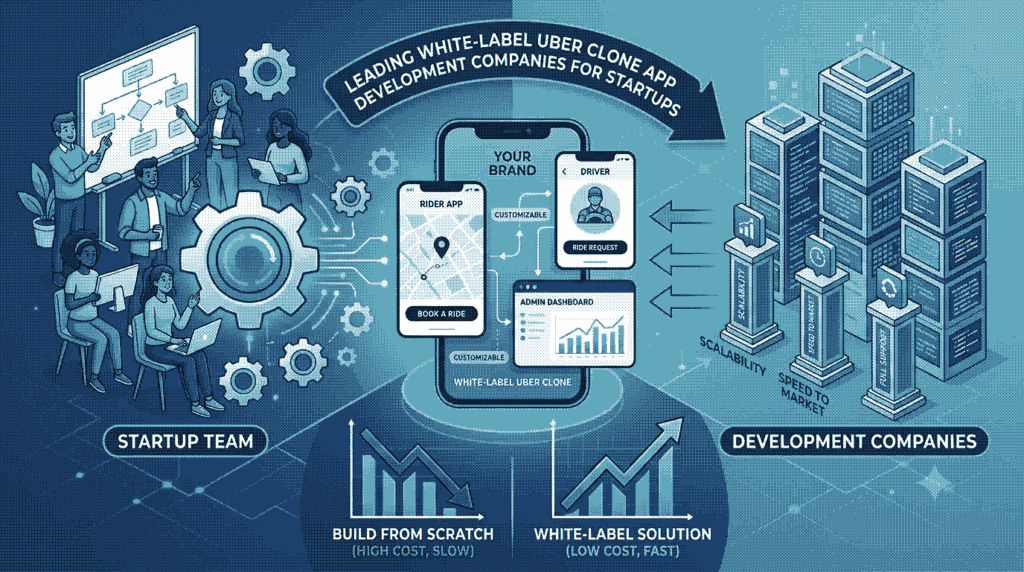

Starting a ride-hailing business has become more accessible than it was five years ago. The infrastructure to run one real-time maps, payment processing, driver management tools no longer needs to be built from the ground up. White-label Uber clone app solutions handle most of that, and the category has matured enough that there are now genuinely good options available at different price points.
But the market has also filled up with vendors selling similar-sounding products of very different quality. Some platforms are well-built, actively maintained, and genuinely ready for a startup launch. Others look polished in a sales demo and create real headaches once you go live.
This article is aimed at founders and operators who are seriously evaluating their options for 2026 not looking for hype, but for a clear picture of what is available, what to look for, and which providers are worth spending time on.
Why White-Label Still Makes Sense in 2026
Custom development costs have not come down. A properly engineered ride-hailing app covering the passenger side, driver side, backend infrastructure, and admin tools still requires a significant team and a timeline measured in months, not weeks.
White-label platforms compress that timeline substantially. The core engineering is done. What you are configuring is the business layer: your branding, your pricing structure, your service zones, your vehicle categories. That is work that can realistically be done in a matter of weeks rather than months.
The argument against white-label used to be flexibility that you would be locked into someone else’s product decisions. That remains a fair concern with some vendors, but the better platforms today offer meaningful custom software, and some deliver full source code. The gap between white-label and custom has narrowed.
For a startup testing a market or launching in a specific city, a white-label solution is still the most practical starting point. The question is which one.
What Has Changed Going Into 2026
A few things are worth noting about how this category has shifted recently.
More platforms now support multi-modal operations meaning a single deployment can handle taxis, bike taxis, auto-rickshaws, or delivery in parallel. That is useful for markets where ride-hailing services often operate across several vehicle types from day one.
AI-assisted dispatch and dynamic pricing have moved from premium add-ons to standard expectations. Platforms that are still running basic nearest-driver dispatch without any intelligent load balancing are falling behind.
AI-assisted dispatch and dynamic pricing have moved from premium add-ons to standard expectations. Platforms that are still running basic nearest-driver dispatch without any intelligent load balancing are falling behind. The impact of AI in app development is also becoming evident here, as AI-driven features increasingly influence how ride-hailing apps handle dispatch, pricing, and operational decisions.
Regulatory compliance tooling has also improved. Features like document verification workflows, trip recording for audit purposes, and configurable fare structures that match local regulations are now common in decent platforms. That matters increasingly as city governments tighten oversight of ride-hailing operations.
App store requirements have also tightened both Apple and Google have raised the bar on performance, privacy controls, and data handling. Platforms that have not kept their apps updated to meet current standards create avoidable problems at the point of submission.
What to Evaluate Before Choosing a Platform
Ownership of What You Build
The single most important structural question: do you own the code when the project is done, or are you licensing the right to use the platform? These are fundamentally different arrangements. A license can be revoked or repriced. Code you own is yours regardless of what happens to the vendor.
Some vendors offer both options at different price points. Know which one you are getting before signing.
How Customisable It Actually Is
Every vendor will tell you their platform is fully customisable. What you want to understand is the mechanics of that customisation.
- Can you change the booking flow?
- Can you add a feature that does not exist yet?
- Can you modify the dispatch logic?
- Or are you limited to colors, logos, and copy?
The depth of customisation available is a more reliable signal of platform quality than any feature list.
Active Maintenance and Update Cadence
A white-label platform is software running on mobile operating systems that update regularly. If the vendor is not actively maintaining the codebase pushing updates, addressing OS-level changes, fixing security issues you will eventually find yourself running an app that breaks on new device models or gets flagged by app stores.
Ask when the platform last received a significant update. Ask about their release cycle. This is easy to overlook during evaluation and hard to fix after you have launched on the platform.
Support After Launch
The sales and onboarding process tells you very little about how a vendor behaves six months after you go live. Ask for references from clients who have been live on the platform for at least a year. Find out how quickly critical issues get resolved, and whether there is a dedicated point of contact or just a support ticket queue.
Integration Flexibility
Your ride-hailing platform will need to connect to things outside itself payment gateways specific to your market, SMS providers, mapping services, accounting tools, or driver background check systems. A platform with a rigid integration layer creates friction at every one of those connection points. Open APIs and documented webhooks are signs that the platform was built with real-world operations in mind.
Top Uber Clone Companies for Startups in 2026
The platforms listed here are ordered by the direct industry experience of the author. Uberclone.co and Elluminati lead the list because they consistently perform well in real deployment contexts. The remaining platforms are included based on their verifiable presence in the market and their relevance to startup use cases.
1. Uberclone.co
Uberclone.co sits at the top of this list for a straightforward reason: they focus entirely on uber clone app and that specialisation reflects in the depth and reliability of what they deliver. This is not an agency that builds ride-hailing apps alongside restaurant apps and gym management software. It is a team that works on this specific product category, which means they have encountered and solved the problems that come with it.
- Their platform covers all the core components passenger app, driver app, admin panel, and dispatcher interface without requiring you to stitch together pieces from different vendors.
- Real-time tracking is smooth and handles variable GPS conditions well, which matters in markets where connectivity is inconsistent.
- The admin panel gives operators practical tools: zone management, fare configuration, driver approval workflows, trip history, and earnings tracking not just a surface-level dashboard.
- Multiple vehicle categories can be managed within a single deployment, so a startup offering both taxis and auto-rickshaws, for example, does not need two separate platforms.
- Source code is delivered as part of the package, which means full ownership and no long-term dependency on Uberclone.co continuing to operate exactly as they do today.
- Their pricing structure is suited to startups one-time rather than recurring, which keeps ongoing costs predictable as you scale.
- Post-launch support is part of what they offer, not an afterthought. For founders who are not deeply technical, having a reliable contact when something needs fixing is genuinely valuable.
For a startup that wants a complete, ready-to-configure ride-hailing platform without building from scratch, Uberclone.co delivers a strong foundation.
2. Elluminati
Elluminati has been building on-demand app development providers for several years and has developed one of the more complete ride-hailing platforms available in the white-label market. What separates them from many competitors is the operational depth of their admin tooling, something that becomes apparent not during evaluation, but after you are live and managing a real fleet.
- Their platform supports a broad range of on-demand service types, but their ride-hailing product is well-developed in its own right, covering passenger, driver, and operator needs with appropriate detail.
- The admin panel is genuinely capable: surge pricing configuration, promo and referral management, revenue reports, driver performance tracking, and zone-level controls are all present and functional.
- Payment gateway coverage is broader than many competitors, which matters when launching in markets where Stripe or PayPal are not the primary payment method.
- They have delivered projects across multiple countries, and that experience shows in how their platform handles localisation multi-language, multi-currency, and right-to-left interface support where needed.
- Customisation depth is meaningful: clients can modify the booking flow, add service categories, adjust the driver onboarding process, and extend the platform without needing to work around a locked codebase.
- Their project delivery process is structured and well-communicated, with clear milestones rather than vague timelines. Clients who have worked with them consistently report knowing where things stand.
- Post-sale support is taken seriously. Onboarding assistance, documentation, and follow-up availability are part of their standard engagement rather than optional add-ons.
Elluminati is a strong choice for founders who want an operationally complete platform and a vendor that understands what running a ride-hailing business actually involves day to day.
3. Yelowsoft
Yelowsoft is a ride-hailing software company that has developed a platform specifically designed for taxi businesses and fleet operators. They are more focused on the B2B side of ride-hailing than on consumer-facing app quality alone.
- Their platform includes features relevant to fleet operations: driver scheduling, trip assignment for dispatchers, corporate account management, and detailed reporting.
- They support both app-based and call-in booking workflows, which suits markets where not all customers book through an app.
- Their SaaS model means lower upfront cost, though this trades off against source code ownership and long-term pricing control.
- Most suitable for operators who are running an existing taxi business and want to digitise it, rather than startups building purely app-based services.
4. Jugnoo
Jugnoo is mobility technology company that has built and operated its own ride-hailing services, in addition to offering their platform to third-party operators. The fact that they have run their own services on the same software is meaningful it suggests a higher bar for operational reliability than a company that only sells and never uses its own product.
- Their platform covers on-demand rides, scheduled bookings, and fleet management in a single system.
- Because their platform handles the specific demands of that environment variable connectivity, cash payment workflows, and high-volume urban dispatch.
- They offer a SaaS licensing model, which keeps initial costs lower but means ongoing fees as you scale.
- More suitable for operators targeting South Asian markets or similar demand environments than for those launching in Western markets.
5. Autocab
Autocab is taxi dispatch and management software company that has been in the market for a long time and was acquired by Uber in 2021. They primarily serve established taxi operators rather than startups, but they are worth mentioning in any comprehensive review of the space.
- Their platform is mature and has been used by hundreds of taxi companies, which means the operational bugs have largely been worked out over years of real-world use.
- Integration with iGo their demand network allows operators to receive bookings from third-party channels, which can help smaller operators fill capacity.
- Their focus is on the UK and European markets, and their pricing and onboarding process reflects that they are not structured for small startup budgets.
- Relevant for operators entering markets where traditional taxi dispatch software is still the norm, less so for pure app-based ride-hailing startups.
Making the Right Choice
Narrow your options to two or three vendors, then go deep on each rather than spreading attention across a long list. Request a live demo not a recorded walkthrough and test the admin panel yourself. That is where operational reality lives.
Ask each vendor directly: what does the platform not do well? A vendor who can answer that honestly is usually more trustworthy than one who claims no limitations exist.
Run a cost calculation that goes beyond the initial price. Include customisation costs, app store submission support, post-launch maintenance, and any per-trip or per-driver fees that kick in as you scale. The platform that looks cheapest upfront is not always the most cost-effective one twelve months in.
The right white-label platform is the one that fits your market, your operational model, and your team’s technical capacity, not necessarily the one with the longest feature list or the lowest headline price.