
Why Agentic AI Is Transforming Software Development in 2026
The field of software development has now reached an entirely new age due to the rise of Agentic AI. While the previous generation of AI solutions was only capable of reacting to user prompts, the new generation of AI systems can develop tasks, make decisions, and execute workflows at their own discretion.
In 2026, companies have increasingly begun using autonomous AI agents to speed up software delivery, enhance code quality, and automate repetitive processes. Instead of using the old methods where developers used AI solutions to receive coding help, now engineers work in collaboration with autonomous agents, which are able to complete the whole process of developing software with very little intervention from humans.
Autonomous AI solutions can assess the requirements of the projects, write code, test software, detect any possible vulnerabilities in it and even deploy the applications in cloud environments.
Due to increasing usage of agile methodologies and DevOps in engineering companies, Agentic AI is becoming an essential tool to boost engineering productivity.
As per Consegic Business Intelligence Artificial Intelligence (AI) Market Report, growing enterprise investments in AI-driven automation are paving the way for Agentic AI solutions capable of planning, reasoning, and executing complex software development tasks with minimal human intervention.
What Is Agentic AI? Understanding the Shift from Assistants to Autonomous Agents
Agentic AI implies that such a system is able to actively work towards its goals instead of being passive and only reacting to prompt requests. Conventional AI assistants are reactive in their nature as they wait for requests and complete single tasks in accordance with them.
On the contrary, agentic AI is proactive, as it can split a complicated goal into sub-goals, choose the optimal order of actions, use third-party tools, and evaluate the progress constantly until the task is completed.
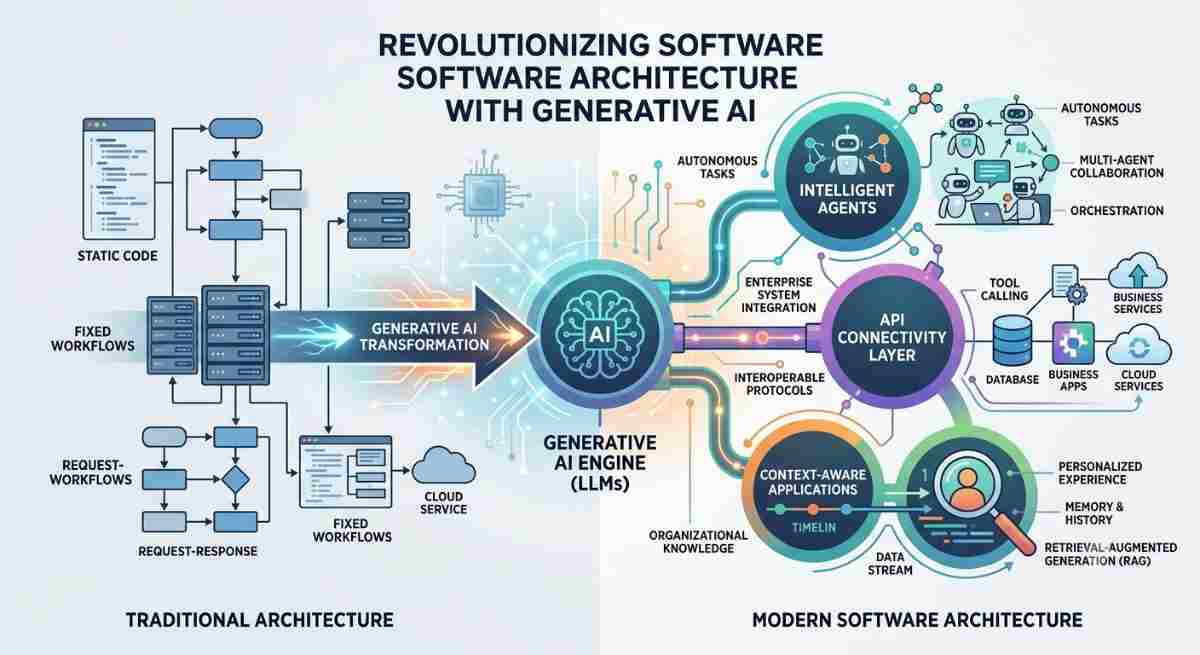
Such intelligent agents usually unite complex large language models with reasoning abilities, planning systems, memory, and even connections with various software tools like APIs, databases, and cloud computing services.
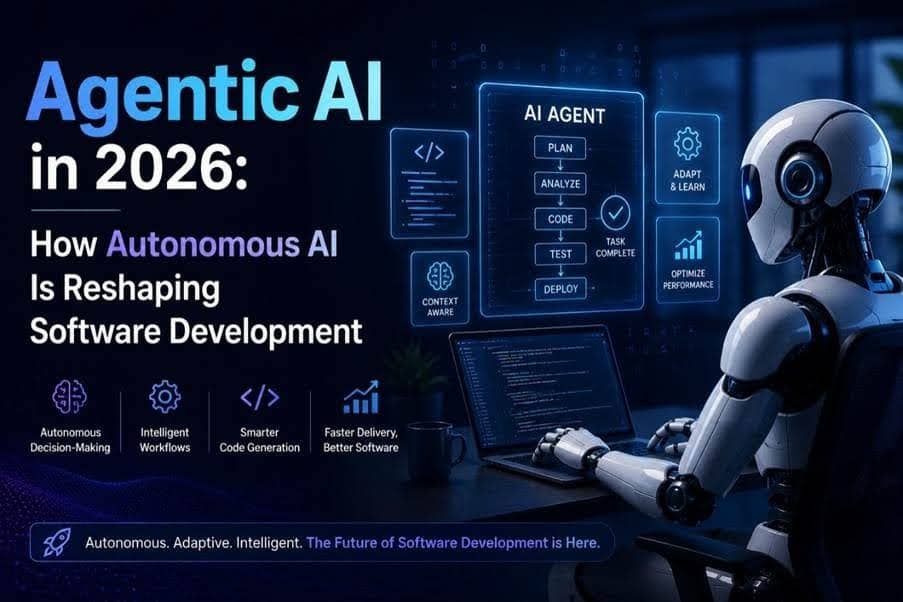
Thus, in software development, an AI agent will be able to assess requirements, generate implementation strategies, write code, run tests, fix bugs, and set up deployment pipelines. Software developers will have to control the overall processes strategically, while the actual execution will be performed by AI.
This marks a serious change from AI-powered assistants to the AI teammates. Organizations get a new level of productivity as engineers can do more in less time consistently and in large volumes.
How Autonomous AI Agents Are Changing the Software Development Lifecycle
The autonomous AI agents are affecting all the stages of the Software Development Life Cycle (SDLC). In the planning phase, such systems are able to study business requirements, propose software architectures, evaluate timelines, and define the risks that the project might face. At the design phase, these systems create technical documentation, create workflows, and propose scalable system designs.
During the development, they are creating production-ready code, automating repetitive programming tasks, reviewing pull requests, and suggesting optimizations of the code following the coding standards. Testing has also improved with the help of autonomous agents that create test cases, perform regression testing, detect defects in the code, and provide recommendations for the fixes even before the software is moved into production.
In DevOps environments, autonomous agents are automating provisioning of infrastructure, monitoring system state, optimizing cloud resources, and helping in CI/CD pipeline processes. Even in the post-deployment stage, these systems are monitoring the performance of the application, detecting anomalies and predicting failures, as well as providing recommendations for the maintenance improvements.
The agents are not going to replace engineers but only complement them by taking over the routine engineering tasks.
Key Benefits of Agentic AI for Developers and Engineering Teams
Agentic AI has a range of benefits which go far beyond mere automation. Firstly, developers become more productive as autonomous agents are able to perform tedious tasks like documenting code, testing and debugging it, as well as generating code.
This way developers get more time for resolving technical issues and developing new functions. Another benefit is related to improved software quality, as agentic AI performs continuous code analysis, finds security vulnerabilities, enforces coding standards, and finds performance bottlenecks prior to the deployment stage.
Faster development cycles are another great benefit of using agentic AI as organizations are able to develop their software on a regular basis. Engineering teams can collaborate better since AI agents can provide information about changes in projects, documentations, and communicate with other departments.
Moreover, AI systems enable continuous learning through adaptation to organizational coding standards. Lower operating costs become a reality for companies due to lower effort and effective resource allocation. With the complexity of software projects increasing, it is now possible for engineering teams to scale operations without a rise in the number of people employed by virtue of agentic AI.
Real-World Applications of Agentic AI in Modern Software Development
Agentic AI is currently being deployed within software engineering processes across different sectors today. Tech firms make use of AI agents to automatically create application codes, test them, and even deploy them. The financial sector makes use of AI agents to ensure transaction monitoring, security vulnerability assessment, and regulatory compliance when software systems are being updated.
The healthcare sector uses such systems in order to facilitate medical software development. In cybersecurity, autonomous agents perform continuous scans of source code in order to determine vulnerabilities and prioritize risks and even recommend measures. E-commerce firms use Agentic AI to provide personalized user experience and at the same time manage their software maintenance processes. Cloud service providers make use of AI agents in order to configure their infrastructure and optimize their computing resources and reduce any kind of downtimes.
Even startups can make use of the technology in order to accelerate development of products with limited engineering resources. Across different sectors, this technology is helping in decreasing development times and improving software quality and speeding up innovation. With advancement in the AI technology, the actual adoption of the technology will spread to almost every sector which relies on software systems.
Read More: Why Every Business Will Need AI Agents by 2030
Challenges, Risks, and Ethical Considerations of Autonomous AI
Nonetheless, despite the many advantages associated with this technology, there are various challenges that have to be considered and addressed when using Agentic AI. In some instances, autonomous systems could develop erroneous code, make faulty decisions or misunderstand project requirements, and thus pose issues related to reliability.
Another challenge pertains to security since AI agents have access to sensitive code libraries, APIs, databases, and cloud infrastructures among other resources.
Thus, it is necessary to ensure that measures are put in place to ensure no unauthorized activity or data leakage takes place. There are also ethical issues related to accountability in case of decisions made by autonomous agents that affect software development and organizational operations.
For instance, there is a need for a clear framework that determines what kind of human involvement there should be in making decisions and accountability in relation to actions performed by autonomous AI agents.
In some instances, bias in models used by autonomous systems could lead to biased decisions that could introduce faults into software application. Finally, overreliance on such technologies could lead to deterioration of problem-solving abilities among developers.
The Future of Agentic AI: What Developers and Businesses Should Expect Beyond 2026
The future development of Agentic AI involves an increasing degree of autonomy and collaboration in the software development environment. With further improvement of the reasoning skills, memory, and multimodal AI, the autonomous agents will handle more complex engineering activities requiring little human interaction.
- In the future, the developers will control teams of specialized agents tasked with such functions as the design of the architectural solutions, coding, testing, security analysis, deployment, and performance monitoring. The enterprises will increasingly implement the multi-agent systems, which will allow solving complicated software problems in a better way than using one AI model.
- In the future, the human developers will be engaged in strategy development, innovation, design, governance, and ethical control, instead of repetitive implementation. Businesses should also prepare for the increasing level of integration of Agentic AI, cloud platforms, cybersecurity solutions, and enterprise development tools.
The future success of the enterprises will require them to ensure transparency, security, and responsible AI governance. Companies that unite talented engineers and trusted autonomous AI solutions will enjoy many competitive advantages thanks to the faster development cycles and software quality. Starting from 2026, Agentic AI will become an important part of modern software engineering.
Conclusion
The development of software in the modern world with the help of Agentic AI has changed its face as it goes far beyond automation and brings autonomous intelligent collaboration into software development.
Thanks to the usage of AI agents for planning, coding, testing, deployment, and even maintenance of software, companies can increase their productivity, improve code quality, and decrease operational expenses.
Though there are some risks associated with such technology from the point of view of security, ethics, and governance, all these problems may be handled appropriately with responsible implementation and human control.
Thus, Agentic AI does not take jobs from programmers but helps them concentrate on innovation, creativity, and strategic decisions. Autonomous AI systems will keep developing and those businesses which will apply them properly keeping being transparent and accountable will be ready to compete successfully in the future.