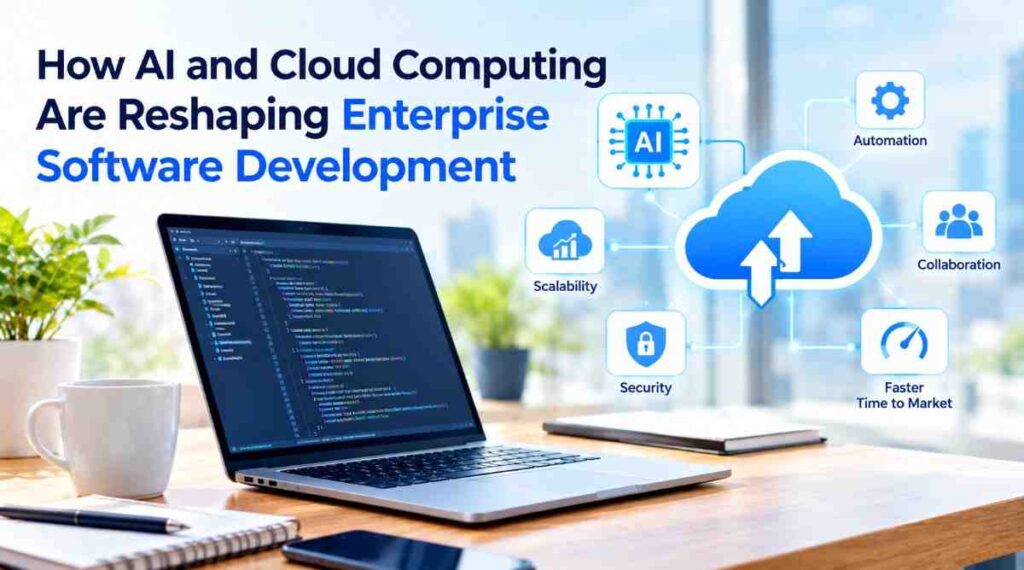

The development of enterprise software is experiencing a major change in the use of cutting-edge technology for developing fast and intelligent software solutions. AI and cloud computing are making significant changes to the SDLC process by automating operations, enhancing collaboration, and bringing in innovation.
The rising cloud computing is helping enterprises gain flexibility in developing their infrastructure and computing power and giving them access to modern development platforms. With the help of tools that are based on AI and infrastructure that is built in the cloud, enterprises can develop intelligent software and automate their development process.
It has made way for an age of enterprise software engineering where automation, agility, and data insights play crucial roles.
AI Transforming the Software Development Lifecycle (SDLC)
The software development lifecycle (SDLC) process is changing due to the emergence of technologies that involve AI in various stages of software development. AI technology is useful for analysis of requirements, programming, improvement of the workflow and boosting application performance in the software development cycle.
AI technology in the planning and development stages of the development process can detect patterns using the historical data and make recommendations on how to act more efficiently. The combination of AI and cloud-based software development is gaining popularity due to the development of cloud computing.
1. AI-Based Requirements Analysis and Software Planning
Artificial Intelligence (AI) is helping with software planning and requirements engineering through techniques such as predictive analysis, natural language processing (NLP), and machine learning. AI-based tools, which use natural language processing, will help the analyst identify the important requirements and priorities for the software development from the business requirements, user stories, and project documentation.
Predictive analytics will help teams predict project duration, allocate resources, and make the right planning decisions based on historical development data. Artificial intelligence-driven recommendation engines will assist architects and project managers in choosing appropriate approaches to software development and implementation. The emergence of cloud-based AI systems is adding more value to those processes.
2. AI-Powered Coding and Application Development
Coding that uses AI technology is currently being achieved through the use of AI-driven technologies such as generative AI, large language models (LLMs), machine learning models, and automated code generators. Such technologies help developers by offering code suggestions, proposing programming solutions, and improving the current application components. AI-driven IDEs can help developers through the analysis of coding patterns, giving recommendations in real time, and facilitating more rapid software development processes. Cloud-based development platforms can enable this by providing scalable computing environments along with the use of AI models.
3. AI-Driven Testing, Debugging and Software Optimization
AI is changing the way software testing and debugging are performed using techniques such as machine learning-based testing, test automation, anomaly detection, and predictive analysis. The AI testing software is capable of evaluating the performance of an application, generating test scenarios, and suggesting possible improvements during the entire life cycle of the software development process.
The use of machine learning allows finding the anomalies in code, analysing the patterns of the system, and conducting faster debugging procedures by defining the reasons behind the problems with the software. AI-powered optimization systems constantly monitor the performance of the application and make suggestions for its improvement.
Cloud Computing Enabling Modern Software Development
Cloud computing is giving rise to a new model of software development for enterprises through its scalability, resource flexibility, and sophisticated development environment. As opposed to the traditional software infrastructure, in cloud computing, organisations can have access to computing power, storage power, databases, and tools for development.
Infrastructure-as-a-Service (IaaS), Platform-as-a-Service (PaaS), and Software-as-a-Service (SaaS) technologies are helping organizations to make their software products efficiently. With the growing cloud computing demand, the development of software through cloud models is gaining momentum rapidly due to increased innovation and efficient use of resources.
Cloud computing is also facilitating collaboration among developers in a distributed manner without any restrictions on the access to application resources.
1. Cloud-Native Architecture and Scalable Software Development
Cloud native technologies include microservices architecture, containers, Kubernetes, and serverless architectures, which have transformed the way companies develop applications. With the microservices architecture approach, applications are developed individually and independently of each other to allow for scalability. Containers provide a single environment for the applications, while Kubernetes provides automation in the deployment and scalability of containerised applications.
In addition, serverless technologies minimise the need for infrastructure management by allowing applications to run through cloud-based services. Technologies like the ones mentioned are becoming increasingly popular in the context of the growth of the cloud computing, which makes it possible for enterprises to create very flexible software solutions.
2. CI/CD, DevOps and Faster Software Deployment
The deployment of software through technologies like continuous integration and delivery (CI/CD), DevOps automation, and cloud-based development pipelines is being facilitated by cloud computing. With the help of CI/CD toolsets, developers can easily automate the process of code integration, testing, and delivery of the applications, making the process faster.
DevOps approach involves the amalgamation of development and operations processes, ensuring better collaboration and monitoring of the software. Cloud computing provides automated tools for source code management, deployment orchestration, and application monitoring with the help of tools like cloud-based pipelines and infrastructure automation.
AI and Cloud Integration Driving Intelligent Enterprise Applications
The combination of AI and cloud computing is helping enterprises create smart software applications that can offer automation and analytics features. Cloud computing technology provides the necessary computing infrastructure needed for the training, deployment, and management of AI models in an enterprise environment.
Technologies like machine learning platforms, cloud-based artificial intelligence, and APIs are helping software developers infuse intelligence within the business applications. The constant growth in the cloud computing is helping organizations utilize AI capabilities without the need for internal infrastructure development. The combination of AI and cloud computing technology will help software applications handle big data, derive insights from it, and automate business processes.
1. AIaaS and Intelligent Automation in Enterprise Software
AI-as-a-service (AIaaS) is changing the face of enterprise software applications due to its easy-to-use AI capabilities in the cloud computing world. Machine learning APIs, natural language processing services, computer vision models, and predictive analytics solutions enable application developers to implement intelligent features easily in their software applications.
Cloud computing providers provide scalable AI computing environments that allow businesses to build, train, and deploy AI models without any significant investment in infrastructure. The surge in cloud computing, driving the adoption of AIaaS solutions across industries by making sophisticated technologies more accessible to enterprises. With AI and cloud computing-based intelligent automation, the management of workflows and customer experience is enhanced.
Business Benefits of AI and Cloud-Based Software Development
Business benefits are being experienced by both AI and software development based on cloud technology due to improvements in the speed of innovation, efficiency, and scalability. The use of AI technology helps in minimising activities that are done repeatedly, while cloud computing helps in offering flexible environments that can be used in developing enterprise applications.
Automation frameworks, analytics platforms, and cloud-native development tools are some of the technologies that can be used by companies in order to optimise their software delivery processes. There is an increase in cloud computing that allows enterprises to benefit from advanced development capabilities.
Future Trends Shaping Enterprise Software Development
The future of enterprise software development will be defined by the advent of new technologies that incorporate aspects of artificial intelligence, cloud computing, and automation. AI-based software development techniques are making available the concept of autonomous software engineering whereby intelligent software agents help in writing, testing, optimizing and managing software applications.
Low-code and no-code platforms have made it possible to create applications quickly by offering users a way of developing applications without necessarily requiring any programming knowledge. Edge computing is making cloud technology more powerful through the processing of data close to the connected devices. Growth in the cloud computing market is helping with the realisation of all these innovations.
The advent of AI-first development has revolutionized software engineering by introducing intelligent automation in application creation and management. Technologies like AI-first agents, low-code development tools, edge computing and cloud orchestration services have made it possible to build software at faster rates and with greater flexibility. Low-code/no-code software development solutions provide an option for business teams and developers to build applications visually without increasing complexity and time. Edge computing supports cloud computing and provides a mechanism for processing information nearer to users and devices to increase application performance. The growing cloud computing module is providing the necessary infrastructure to link these solutions together.
Development of Next Generation Intelligent Software Ecosystems
The emergence of Artificial Intelligence (AI) and cloud computing has revolutionized the process of software development by making software intelligent, scalable, automated, and responsive to changes in the business environment.
AI-enabled software development life cycle (SDLC) processes can bring improvements in requirement analysis, coding, testing, optimization, and deployment in enterprise application development.
Cloud computing provides the platform for all these advancements through flexible infrastructure, development environment, and easy availability of computing resources. Growth in cloud computing has resulted in rapid adoption of intelligent software ecosystems driven by AI features.
According to Pristine Market Insights, the combination of AI and cloud computing technology marks a major shift in software engineering. As the enterprises are adopting both these technologies to drive innovation, increase productivity, and better digital transformation results.