
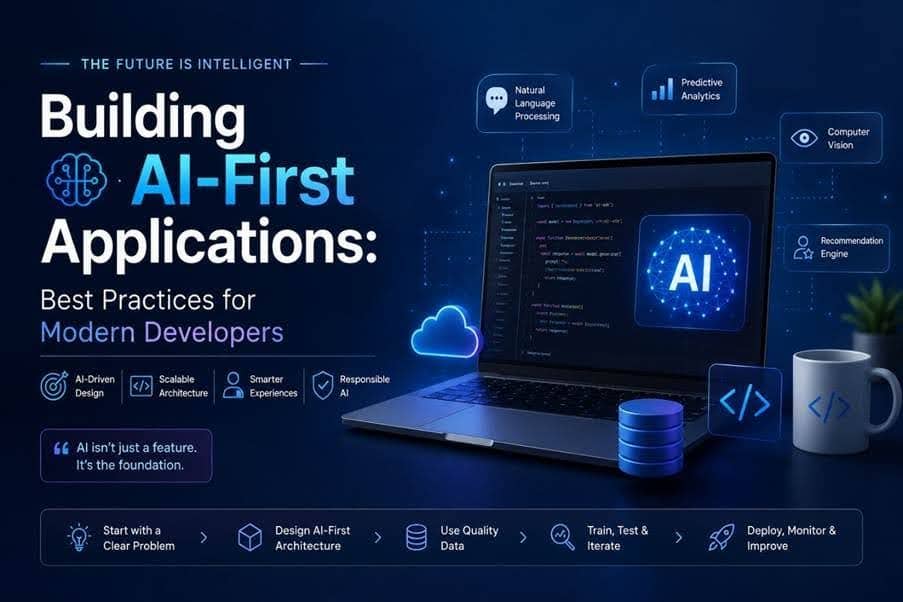

Introduction: The Rise of AI-First Application Development
Artificial Intelligence is revolutionizing the way modern software applications are being developed and designed. While conventional software applications mostly depend on fixed sets of rules and determinate logic, AI-driven applications prioritize intelligent models at the core of their architecture and the end-user experience.
Such applications are able to understand natural language, create content, recognize images, make predictions, perform repetitive tasks, and adapt to new user needs.
Thanks to the widespread availability of large language models, machine learning API, computer vision systems, and cloud AI solutions, complex AI functionalities have become available for developers without needing to develop each model individually.
However, developing an AI-first application is not limited to adding an API into one’s application. Developers need to take into account a number of other factors such as model choice, data quality, prompts, latency, security, scalability, costs, and reliability from the very start.
The best AI-first strategies start with knowing when intelligence is really worth adding, rather than simply deploying AI for the sake of AI. The developer needs to look at what problems do humans have and where AI might be helpful in decision making and automation. With good product design and the right AI tools, developers are able to build intelligent applications.
As per Consegic Business Intelligence, the Generative AI Market is growing at an accelerated pace as companies are leveraging AI functionalities in software development, cloud computing, and intelligence applications, indicating the rising significance of AI-first application development.
Designing Applications Around AI Capabilities
An AI-first app involves changing the mindset on software development. Instead of considering AI as another feature that comes in the later stages, once the core application is developed, it is best to find where AI can be used at the product design phase. It is necessary to solve a real user problem with the help of intelligent capabilities rather than integrating AI just for the sake of technology.
First, developers need to define where language understanding, prediction, classification, personalization, recommendations, automation, and pattern recognition is involved. Such processes can greatly utilize AI since models process huge amounts of information and deliver valuable output in no time. The user journey needs to be designed based on these processes while ensuring that interaction and outputs remain clear.
In addition, AI applications should have adequate user control. Human involvement can play a significant role in decision-making to avoid mistakes and establish trust when required. Users should be informed where AI is generating content, providing suggestions or processing information.
One of the key things to consider is graceful failure. Sometimes the output of AI can be wrong, incomplete, or even unpredictable. Therefore, it is necessary to have validation techniques as well as fallback mechanisms and good error-handling.
Choosing the Right AI Models, APIs, and Tech Stack
Model and technology selection play a crucial role in building AI-first applications. Models need to be selected in relation to the needs of particular applications, and the biggest or the best models do not necessarily need to be used.
The large language models are applicable in cases of conversational UIs, summaries, content generation, coding, and document analysis. The smaller models might prove to be more suitable in cases when latency needs to be low, or costs need to be kept down, among other factors. Similarly, different computer vision, speech recognition, recommendations, and predictive analytics models can be chosen depending on their use in particular applications.
AI services based on APIs can expedite development processes since developers get access to sophisticated functionalities without having to maintain complicated infrastructure of models. However, in case when an application has strict privacy requirements, or large numbers of requests are expected, custom or self-hosted models may be a better fit.
The entire technology stack must also be efficient when processing data, performing authentication and monitoring, storing data, and deploying the application. The use of modular architecture will ensure that any model within the system can be updated or replaced without having to rebuild the whole application. This becomes important considering how quickly artificial intelligence technologies continue to change.
Best Practices for Data, Prompt Engineering, and AI Integration
Data is an integral part of successful AI application development. Even the most advanced models will give bad outputs if they are not provided with sufficient, up-to-date, relevant, and properly structured input data. Therefore, there should be processes developed to gather, clean, structure, validate, and securely manage application data. If the application uses proprietary organizational data, approaches like retrieval-augmented generation may be used to provide the model with proper information without retraining the underlying model.
Another critical aspect of building AI applications is prompt engineering. The developers need to design the model’s task, context, behaviour, and output through structured prompts. The examples and constraints could help in getting better and more consistent results. The prompts must be version-controlled and tested systematically and not simply considered as informal text.
The integration of AI models into the applications must happen through proper application interfaces. It would help the developers keep the model-related logic separate from other business logic to update the model without disturbing the other logic in the application. The output validation is equally essential, especially when the output is to be used in other systems.
It would also be helpful for developers to use realistic and diverse inputs while testing their applications. This could help in discovering the problems through improper response or output and user feedback which may not come in regular software testing.
Building Secure, Scalable, and Reliable AI Applications
Security and reliability should be taken into account even during the first stages of developing AI-based applications. AI technology brings specific risks that do not apply to classic applications, namely prompt injection, exposure of sensitive data, unauthorized access to models, malicious input, and unreliable generation. The developer should consider authentication, authorization, encryption, secure API management, and proper access control to ensure the safety of both the user and the application itself.
The issue of privacy arises whenever applications deal with personal, confidential or business information. The developer should limit unnecessary data gathering and define what data is going to be sent to AI service.
Scalability is yet another important factor to consider. It may prove to be resource-heavy, especially if an application supports many users. Developers are able to increase efficiency by caching, batching requests, choosing models, making asynchronous requests, and allocating resources optimally. By monitoring latency and infrastructure utilization you will be able to detect bottlenecks before your end-users do.
Reliability implies that the application must prepare itself for model failures and random responses. Fallbacks, validation, rate-limiting, and human intervention should be considered for important processes. AI results cannot be trusted just because they come from a complex model.
By implementing proper security measures, efficient use of infrastructure, validation and system design, developers are able to ensure reliability of their applications.
Testing, Monitoring, and Continuously Improving AI-First Applications
For testing of AI first applications, there must be a wider strategy as opposed to what is required during the process of software testing since the AI outputs can differ even with the same input. In the evaluation process, developers must check whether the applications have accuracy, relevance, consistency, safety, latency, and overall user experience.
Evaluation can be done through the development of an evaluation strategy using pre-determined datasets which will contain representative user queries and outcomes. Developers will then test how models respond by comparing results. Automatic evaluation can assist in detecting problems when the prompt, models, or the application logic is altered.
Continuous monitoring must also take place once the applications are deployed. Developers should monitor such metrics as response time, error rate, number of tokens used, cost, user experience, and frequency of generating wrong results. Logging must be done with caution such that there is no unnecessary retention of sensitive data.
Feedback from the users is a useful source of information that automated testing may fail to detect. Developers can evaluate the common complaints, failed interactions, and repetitive questions to enhance the prompts, retrieval systems, workflows, or even the model itself.
AI applications should thus be viewed not as static solutions but rather as dynamic systems in constant development. Continuous performance monitoring enables developers to catch emerging problems, and to respond to changes in the model, data sources, user requirements and security threats.
Conclusion
The creation of AI-first products involves not only embedding artificial intelligence into software products. The success of such products lies in choosing the right model, ensuring data quality, creating appropriate prompts, and constructing robust and secure architecture.
Developers should focus on reliability by introducing validation procedures, human supervision and fall-back solutions, where needed. It is also important to monitor and test such AI systems regularly in order to improve their performance along with models and technologies becoming more complex.
Finally, AI-first development is all about applying intelligence to solve problems. By combining good product design, responsible AI usage and flexibility of technology stack, modern developers can create intelligent products.