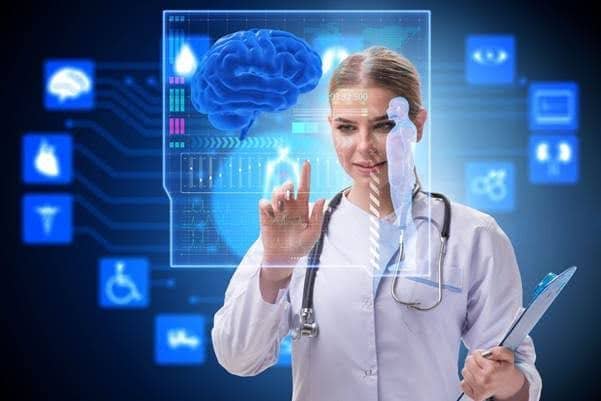

Enhancing Disease Diagnosis with AI AI is revolutionising medical diagnostics and offering a significant breakthrough towards discovering diseases faster and with enhanced accuracy. Through the analysis of numerous amounts of medical data, AI enabled systems may be capable of recognising patterns that could not potentially be recognised by humans. These systems may come across various applications such as medical imaging, lab testing, predicting analysis and planning personalised care that would include but not restricted to AI medical diagnosis.
Thanks to widespread adoption of intelligent tools, the clinical field relies heavily on technology for improved medical judgment, prevention of mistakes, and to speed up time to care. Most hospitals, laboratories, as well as research centers today are keen on purchasing or implementing machine learning technologies, whether that’s with patients in mind or for more administrative processes.
What Is Artificial Intelligence in Medical Diagnostics?
Use of machine-learning algorithms to identify diseases in medicine and Healthcare use deep learning models and other technology for diagnostics, Artificial intelligence to identify a diseases using by reviewing and Analyzing pathology and imaging reports, lab tests , electronic charts and genomic and DNA information. In medical diagnostics , AI combines together sophisticated algorithms with complex and sensitive medical data.
Compared to traditional diagnostic technique based on static human inspection and analysis, the AI approach continuously improves by having access to extensive data sources for continued training. As AI adapts the ability to achieve diagnostic decisions much faster and identify the disease at a very initial stage.
Technologies Powering AI Diagnostics
Behind the Scenes: the Technologies Powering AI-Driven Diagnostics Machine learning (ML) models parse past patient data to detect trends of disease occurrence. Deep learning ( DL) technology, the ML subgroup used here, sifts through intricate medical image data including scans of X-ray, computer tomography (CT), magnetic resonance imaging (MRI), and ultrasonography to predict presence or absence of certain conditions, and Natural language processing(NLP) allows information extracted to the text based on clinical reports or records stored in a computer aided medical (Electronic Medical Records) device.
The expanding artificial intelligence in medical diagnostics market is being driven by increased adoption of cloud computing, medical imaging software, predictive analytics, and digital healthcare platforms. These technologies enable healthcare providers to improve diagnostic accuracy while supporting more efficient patient care.
AI in Medical Imaging
One of the highest-level uses for artificial intelligence is in the medical imaging world. AI algorithms scan medical image files and help identify abnormal features within them, alerting radiologists to focus on specific points and highlighting cases that need the highest urgency so they can be handled first-leading to greater workflow and less miss rate.
In AI enhanced imaging applications used by radiologists and medical staff for all sort of screening, Cancer, brain disorders, Heart conditions, breaking & respiratory Diseases are all very common such example. The advantage behind the images are, that the faster processing speeds up doctor diagnosis which improves quality and outcome from patients’ lives and treatments.
Applications Across Healthcare
How Artificial Intelligence Is Helping Modern Medicine ai in healthcare Artificial intelligence technology applications include being used by hospitals and diagnostic laboratories. Many hospitals and healthcare institutions have begun using predictive analytics and machine learning techniques to pinpoint and manage patient populations who run a higher risk of severe health complications. Laboratories may use computer imaging software to conduct machine learning–assisted analysis and examination of slides, blood, or lab samples that allow physicians to make more effective and customized treatment recommendations-part of the trend toward precision medicine.
How about AI integration and development into our healthcare facilities? AI and ML are being used by clinicians all over the world to enhance the diagnosis and monitoring of disease states, suggest proven and best treatment guidelines, and help build efficient and client-centric healthcare facilities worldwide.
Benefits of AI in Medical Diagnostics
There are many potential advantages to the healthcare community – both patients and their caregivers – which come with using AI. For starters, use of this technology enhances speed of diagnostics, improves accuracy, minimizes human error and even facilitates early detection of diseases. Also, using this technology helps ease the burden on health care practitioners and helps save them precious time that can then be dedicated to patient care and clinical judgment in more complicated scenarios.
Through massive quantities of healthcare information processed instantly with our cutting-edge tech, these artificial intelligence health care benefits mean conditions get located quicker. As an included perk, facilities don’t have wasted supplies or doctors working at a disadvantage of understanding precisely what’s occurring right after possible in an AI healthcare application.
Challenges and Ethical Considerations
However, its development has also created a lot of concerns for several factors and concerns. Data-driven decision making comes with ethical questions. One of the major and the current issues includes ethical challenges of ai in medical diagnostics.
Apart from this, these systems are also facing some challenges including the cost of implementation, Data Privacy & security, regulatory issues and transparent algorithms.
These artificial intelligency devices, require access to huge amounts of accurate information for functioning better, thus require access to reliable training datasets.
Doctors need to know the role that AI can play in augmenting care but without replacing them. With the ethical guidance for responsible execution and persistent vigilance for ensuring the optimum performance of the AI tools, one can have a patient’s confidence and well-being maintained all the time.
Future Outlook
Outlook for AI In Medical Diagnosis: The potential of AI in medical diagnosis is immense and due to exponential growth in research and innovation of AI, machine learning, cloud technology, genomics, and digital health, AI will likely lead to significant expansion in applications and services offered. AI can expand capabilities into preventive care, individual medicine, remote diagnostics, timely disease diagnosis, etc. Further progress will stem from consistent investment in the expansion of health sciences research and in the development of health-related technologies.
The ability to blend data driven-insight with the expertise of clinicians will pave the way for a healthier world and better future of medical diagnostics. As the health care centers across the globe endeavors for the optimum in outcomes as well as efficiency, in the times to come, artificial intelligence will stay to be the main element of new.