
Introduction
An evaluation of today’s vehicles includes many factors, apart from the engine, efficiency, and outer look. Software is required not only for the navigation system and driver assistance technology but also for the battery, vehicle diagnostics, and customer experience. Earlier, software operations were limited to ensuring the functioning of the car components but now its contribution extends to the overall efficiency and performance enhancement.
This is a stage of time involving the emergence of a software-defined vehicle (SDV), of which the utmost leverage is provided for several operation functionalities and changes post manufacturing. The transformation is done alongside the transformation of the electric and connected automotive sector. Already in 2024, over 17 million EVs were sold globally, accounting for more than 20% of the total car sales worldwide.
The Shift from Distinctive Controllers to Complete Computing
Classic vehicles make use of electrical control units (ECUs) in order to carry out a range of functions such as braking, regulating the engine, lighting and operating the climate. Depending on the type of vehicle, a car can contain anywhere from 50 to 100 ECUs. Each controller has its own purposes and responsibilities, but the existence of so many controllers presents a problem of connectivity.
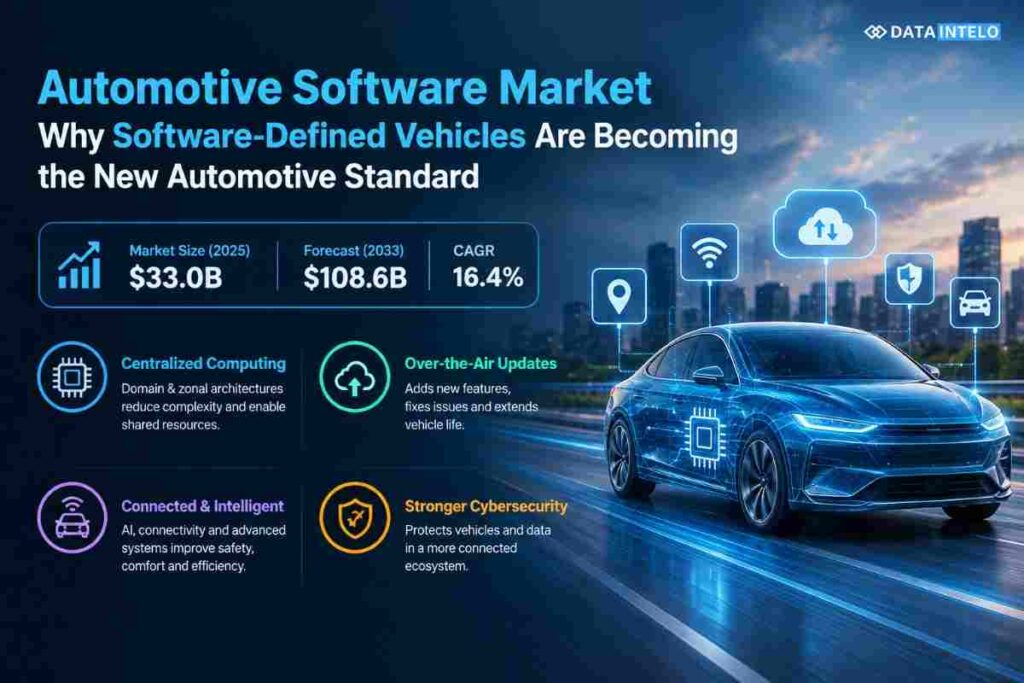
In software-defined vehicles, multiple functions can operate through shared computing systems rather than relying entirely on separate controllers. This setup allows manufacturers to manage different vehicle features through a more connected electronic architecture. It can also make future software improvements easier to introduce, provided the existing hardware can support them.
OTA Updates Extend Software Life
Over-the-air (OTA) updates enable manufacturers to modify their software without making use of wired connections. The updates provide advancements in navigation, entertainment systems, diagnostics, and even some of the newer driver-assistance features without needing to take the car to the service department. This technology is important since cars can be driven for 10-15 years while their software will need to be updated much sooner.
Successful OTA deployment involves more than just having a strong internet connection. The vehicles also need to check the update’s authenticity, compatibility with hardware, and restore capabilities in case of failure. The manufacturers can also use staggered rollouts to figure out if there is a problem prior to using the update for the entire fleet.
The rise of software importance in car construction is indicated by the market expansion. As per Dataintelo, the automotive software global market value will be $32.8 billion by 2025 and will increase up to $78.62 billion by 2034 which means the compound annual growth rate of 10.2%.
The increase of $45.82 billion indicates the growing significance of software in vehicle development, connectivity, diagnostics and driver assistance. Software becomes more and more important for both new car development and subsequent maintenance as car manufacturers start to utilize more complex systems.
Driver Assistance Systems Require Dependable Software
Software that reads data from cameras, radars, and other sensors is necessary for lane departure warning, adaptive cruise control, parking assistance, and automatic emergency braking systems to work. A video camera captures 30 images in a second and produces 1,800 images every minute. Therefore, when multiple sensors work together, the amount of information vehicles must process can be great.
Driver-assistance abilities do not work properly in all situations. This is due to the fact that the sensors may have failed to take correct information and the software may have failed in interpreting the data accurately. Thus, the presence of heavy rain may block the view of the camera, the danger of glare produced by the sun may sabotage its work, while the faded marks left on the road can impede the operations in detecting the lane. Moreover, abrupt obstacles may make the system switch to handling new circumstances rapidly.
Electric Vehicles Put Software at the Centre
In electric vehicles, software is very important in determining battery charge, cell temperature, regulating the output of the motor and controlling regenerative braking. The battery can comprise a few hundred or several thousand cells, depending on its structure. The system for managing the battery is responsible for monitoring these values to ensure they do not go beyond the safe limits of operation.
In 2024, more than 17 million units of electric cars were produced globally which is about 3.5 million more than in 2023. The growing popularity of electric cars causes more challenges to manufacturing companies in terms of charging efficiency, energy consumption and thermal maintenance of electric cars and their battery control.
Innovations are Changeover Automotive Software
Various digital technologies are being applied to automotive software, but its success depends on the particular abilities of a vehicle, data availability, and environmental conditions where it operates.
- Artificial intelligence. Machine learning systems allow performing tasks like recognizing objects, monitoring drivers, and executing predictive maintenance. The efficiency of such systems is determined by the representativeness of the data used to train them and their testing in different conditions.
- Cloud computing. Cloud platforms allow carrying out fleet diagnostics, distributing software, and analyzing vehicle performance. For instance, if 100,000 vehicles transmit 10 megabytes of selected diagnostic data daily, the amount of transmitted data would equal one terabyte per day.
- Automotive operating systems. Conventional software applications lead to software compatibility across various models of automobiles used.
- Inter-vehicle communication. Vehicles are able to communicate with each other as well as roadside infrastructure. However the benefits of the system depend on devices available in a particular area and the conditions of the network.
- Simulation and digital twins. Virtual vehicle models make it possible to test software changes under different driving conditions before their deployment in practice.
The implementation of these technologies may lead to cost reduction associated with repetition of development activities. However, the efficiency of these technologies is determined by integration, availability of quality information, and testing of solutions.
Comparison Between Conventional Vehicles and Software-based Vehicles
Revolution affects vehicle design, functionality, repair, and maintenance processes. The table below illustrates the advantages and disadvantages of both solutions.
| Feature | Traditional vehicle architecture | Software-defined vehicle architecture |
| Electronic control | Many functions handled by separate ECUs | Functions grouped across domain or central computers |
| Software updates | Often require workshop visits or specialized equipment | Compatible updates may be delivered remotely |
| Feature development | Frequently tied to specific hardware configurations | Software can be reused across compatible platforms |
| Data processing | Distributed across individual controllers | Increasingly coordinated through shared computing |
| Maintenance | Many improvements depend on physical servicing | Selected fixes and improvements can be delivered remotely |
| Security management | Protection may vary across individual systems | Security can be coordinated across connected components |
Neither option is always the best. Standard arrangements work in the case of less complicated machines, while opportunity for centralized systems is easier coordination of complex software. There is a more significant dependence on powerful processors, communication systems, and software platforms in both cases. It’s either the success of architecture implementation or efficient support of the solution.
Long-Term Support in Terms of Cybersecurity
As connectivity develops, security issues also follow. A car, for example, can interact with mobile apps, the cloud, charging systems, and diagnostic ones. Therefore, in case one component fails, all not only connected networks but also other systems that depend on the system will fail with it.
Car manufacturers are beginning to adopt a formalized approach to identifying potential threats in cybersecurity, making regular updates to software in the vehicles, and providing support for any digital systems in use within the vehicle.
Additionally, information gathering leads to the questions of what kind of data is really necessary, for what period of time needs to be stored, and what the reasons for its usage are. Therefore, access management and retention are important as well.
The car manufactured in 2026 may still be on the road in 2030, which means that it should need long-lasting support. Car owners need to know whether various connectivity upgrades and security updates will be available after the car stops being produced.
Conclusion
Software-defined vehicles are gaining importance because digital functions can be developed, coordinated, and maintained throughout a vehicle’s life. Electric powertrains, connected features, driver assistance, and remote updates are increasing the amount of software involved in everyday driving.
The growth of the automotive software market will continue as the manufacturers are expected to focus on development of integrated computing platforms and the use of reusable software. However, future growth cannot be measured by just adding capabilities to vehicles and keeping pace with advancement of software. It should be recalled that cybersecurity, functional safety, software reliability, and support will be of paramount importance.
As automotive technology advances with motor vehicles undergoing transitions from being mere mechanics to being technology-heavy and driven by software solutions, the significance of software will increase as well. Hence, the focus on how to keep and maintain software capabilities will shape the future use of motor vehicles.