
For decades, building software demanded deep expertise in syntax, manual testing, and strict adherence to the Software Development Life Cycle (SDLC). From planning and system design through to source code and deployment, shipping a working application often took months.
Today, both technical developers and non-technical staff are building software using AI models. This trend is widely referred to as vibe coding. A working application can now be assembled in days, and even beginner programmers can build functional web apps with minimal friction.
Vibe coding is an intent-driven practice where a developer describes the requirement in natural language and a generative AI model drafts the code, runs tests, and iterates. The term was popularised by Andrej Karpathy in 2025. It is not the same as AI-assisted coding: autocomplete and boilerplate generation have existed for years, while vibe coding shifts the developer’s main job from writing code to describing, evaluating, and iterating on what the AI builds. For a fuller breakdown of the concept, see our guide on what vibe coding is.
This article covers the tools teams are using, the four places vibe coding genuinely works, and the guardrails that keep it out of trouble.
Why Adoption Is Accelerating
Vibe coding is not a fringe practice any more. Roots Analysis estimates the global vibe coding market will grow from USD 2.96 billion in 2025 to USD 325 billion by 2040, a CAGR of 36.79% across the forecast period.
That projection reflects uptake across four distinct groups: developers offloading repetitive implementation, startups compressing time to first prototype, enterprises automating internal tooling backlogs, and non-technical users building software for the first time. Each group uses the practice differently, which is why a single definition of vibe coding tells you very little about how it actually gets used day to day.
What Changes for the Developer
Input Method
Developers now use natural language prompts to describe complex features, workflows, and fixes in plain language. They can then use AI coding tools to turn those requirements into working code. This reduces the friction in taking an idea from conception to working prototype, especially for simpler features and applications.
Review Process
With vibe coding developers focus on inspecting, testing, debugging, and validating AI-generated output instead of writing everything from scratch. Spotting incorrect assumptions, security gaps, inefficient logic, and integration errors becomes the core skill rather than a final step.
Iteration Cycle
Prompt iteration takes the place of code refactoring and makes smaller editing cycles easier to complete. Prompts are simpler to edit and rework than code, so the loop between “try something” and “see the result” gets much shorter.
Skills Emphasis
Prompt construction, systems thinking, and code review become significantly more valuable than traditional programming skills.
None of this replaces engineering judgment. It shifts that judgment from writing every line to checking the result further down the tool chain.
The Three Tool Categories Powering Vibe Coding
Several tools have made vibe coding practical at business scale. They fall into three groups.
AI Pair Programmers and IDE Assistants
These embed directly inside code editors, read the entire codebase, propose multi-file changes, and execute commands on request. They are built for developers who still want to work inside a familiar IDE while offloading the repetitive parts of implementation.
Full-Stack App Builders
This category takes a prompt and generates a working application, including front-end, back-end, and sometimes a database, without the user ever touching a code editor. These are generally used by founders and product managers who want to iterate on prototypes quickly without pulling engineering resources.
Agentic Coding Assistants
The next generation of AI coding tools goes further, taking users from high-level instructions to fully working applications. The task is broken into smaller steps, then code is written, debugged, reviewed against those steps, and improved.
Four Places Vibe Coding Actually Works
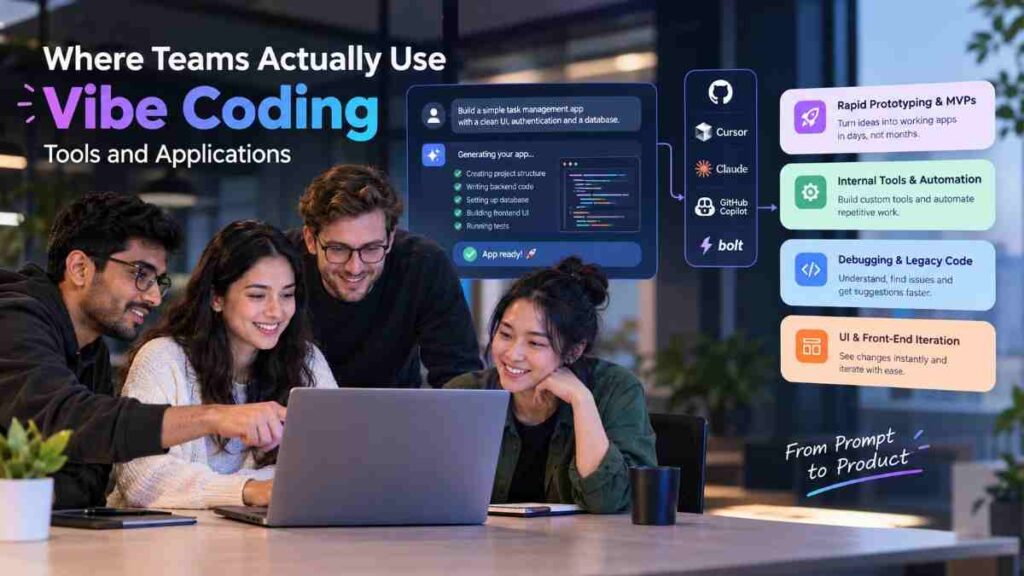
Rapid Prototyping and MVPs
This is where vibe coding is strongest. Turning an initial idea into a clickable prototype takes far less time than spending weeks building something that gets thrown away because nobody wanted it.
Internal Tools and Automation
Most companies carry a long queue of small internal tools, a dashboard here, a Slack bot there, that never get prioritised for a full engineering sprint. Vibe coding makes many of these buildable by one person, turning an impossible backlog into something manageable.
Debugging and Legacy Code Exploration
Developers are now using AI assistants to understand unfamiliar or legacy code. Generative AI tools help define what a function does, locate a bug’s root cause, or suggest fixes. This cuts the time it would take to trace the logic manually.
UI and Front-End Iteration
Front-end work, with its tight feedback loop, suits vibe coding particularly well. A designer or developer can describe a change and see it rendered immediately, then keep iterating in conversation rather than fiddling with CSS.
What Teams Get Out of It
For teams already using it, the gains are consistent:
- Cuts the time needed to build prototypes and internal tools.
- Workable for beginners and non-engineers who want to build a functional app or website.
- Senior developers spend less time on repetitive work and more on architecture and design decisions.
- A real-time feedback loop between idea and working software helps teams validate assumptions earlier.
Best Practices for Using Vibe Coding Responsibly
Treat AI output as a first draft, never a final answer. Review it the way you would review a junior developer’s pull request.
Keep version control discipline. It lets you roll back changes that looked fine at first and turned out not to be.
Write tests, even for AI-generated features. If anything, the untraceable origin of the code makes tests more important, not less.
Reserve vibe coding for prototypes, internal tools, and non-critical features until your team has a proven review process for anything closer to production.
Keep a human owner accountable for every piece of shipped code, regardless of who or what wrote the first version.
Bottom Line
Vibe coding has earned a real place in modern development, but a narrow one. It is strongest where speed matters more than durability: prototypes, internal tools, legacy exploration, and front-end iteration. It is weakest where correctness, security, and long-term maintenance matter, which is most production software.
The shift is not that developers write less code. It is that the expensive part of the job moves from writing to verifying. Teams that treat AI output as a first draft, keep tests and version control tight, and hold a human accountable for every shipped change will get most of the upside. Teams that skip those steps will spend the time they saved on debugging instead.