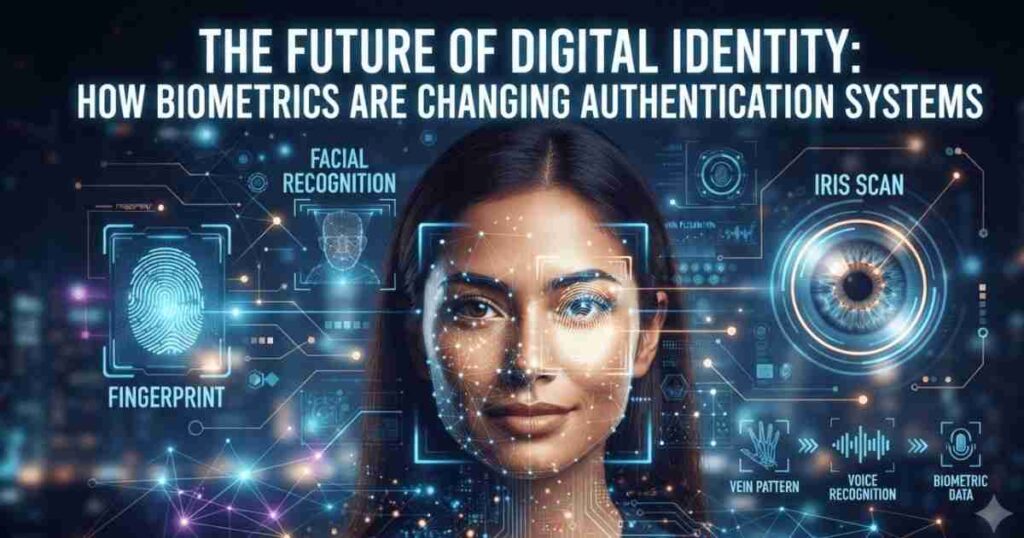

The digital identity space is developing very quickly as companies strive to implement more efficient and secure ways of authenticating individuals in the digital and physical worlds. In addition to traditional password authentication, biometric authentication based on individual human features like face, fingerprint, iris, voice, and behaviour has become an important tool for verifying individuals’ identities. The biometric authentication market is therefore becoming increasingly popular as banks, governments, healthcare organisations, corporations, and digital platforms are incorporating biometric authentication in their identity systems. As digital services continue to become available on a variety of platforms and devices, biometrics move beyond simple authentication and evolve into digital identity ecosystems.
How Biometric Digital Identity Works
Biometric Digital Identity is the process of using human-identifiable characteristics in establishing and managing digital identity. While conventional identities require passwords, personal identification numbers, or even physical cards, biometrics tie the identity to specific human characteristics or actions. This enables the recognition of one’s identity within various digital environments, thus making it possible to create biometric authentication systems by utilizing human attributes.
Biometric Authentication Main Components: The basic process of biometric authentication consists of collecting and digitizing some identifiable trait of a human being, such as fingerprint, face, iris, voice, and many others. Once the digitized version of the trait is collected, the second step in this process is associating it with the identity of the individual. When the individual is made to interact with the system, a new collection of the trait is done and compared with the previously stored biometric data on the basis of some identifiable feature of a human being.
Identity Verification versus Authentication: Identity verification seeks to establish whether the individual is indeed the same individual that he or she claims to be on the basis of biometric information. Authentication comes after identity verification and involves authenticating the verified identity for access to a device, account, application or service. Digital identification employs verification to verify the identity relationship, whereas authentication ensures access.
Major Biometric Modalities
There are various biometric authentication methods, each one depending on a unique physiological or behavioural trait. The selection of the appropriate method is influenced by the environment where the authentication process takes place, the interaction of the user, the capability of the device used, among others. In all, these approaches are making it easier for people to authenticate their identities within digital mediums.
- Facial Recognition: It is the analysis of the unique measurable attributes of an individual’s face, including the structural relationship of facial attributes. This method is being adopted within smartphones, border controls, financial applications, and online onboarding, among others.
- Fingerprint Recognition: It refers to the use of distinct patterns of ridges that are captured using any of the various sensor technologies available, including optical, capacitive, and others.
- Iris Recognition: It involves the use of unique features that exist in the colored part of the eye to identify individuals. This is due to the detailed features that exist in the iris.
- Retinal Recognition: It relies on the examination of the vascular pattern of the eye at its back end. Retinal recognition is mainly linked to specialised environments where authentication is required.
- Voice Biometrics: It involves the assessment of the vocal and speech patterns of an individual to identify his or her identity.
- Behavioural Biometrics: It includes how a person uses electronic devices. The way of typing, using a mouse, and other actions on touchscreens or use of the device are some of the parameters included in behavioural biometrics.
Infrastructure Required to Implement Biometric Identification Technology
Biometric authentication is currently dependent on an infrastructure comprising advanced algorithms, sensors, a computing environment, and security measures which work collectively to turn the biometric traits into secure signals representing the digital identity while ensuring a fast authentication process on devices such as smartphones, enterprise networks, financial applications and other networked environments.
Artificial Intelligence and Machine Learning
In the process of authentication, the algorithms can match the recently acquired biometric traits with the already enrolled profiles to determine how similar they are. Machine learning can be improved continuously to allow for adaptation to variations in lighting, orientation of the face, voice and other factors.
Liveness Detection and Spoof Prevention
The live detection method will confirm whether the biometric information collected is genuine and not a replica in any form. Based on the modality used, the system will analyse various physiological elements such as the movements of the face, depth, texture, eyes, among others, prior to conducting the authentication. The anti-spoof techniques, on the other hand, will detect any attempt to present photographs, video clips, as well as any form of a manipulated biometric sample.
Cloud Processing and Edge Processing
Cloud processing provides biometric solutions with scalable computing capabilities to manage identities, implement algorithms, and authenticate users through their distributed applications. Edge processing brings the computing processes closer to the device or the point of authentication to analyse the biometric information without the need for any network communication. Both techniques enable organizations to implement the authentication processes efficiently within the interconnected digital identity world.
New Biometric Authentication Experiences
There is a transformation happening regarding authentication due to biometric technologies being used. These authentication experiences will no longer depend on the information provided by users. The systems will be able to verify the user based on their physical and behavioural traits, instead of the information they should remember or type in.
Passwordless User Authentication
- Biometrics as Primary Identifiers: The use of biometric features can be a way of accessing the device, application, and the digital platform by allowing user authentication based on facial recognition, fingerprints, or any other biometric feature without typing passwords.
- Authentication through Biometric Access Using Devices: The connection between devices such as mobile phones, computers, and tablets means there is biometric access technology built into these devices for authentication purposes.
- Biometric Logins: Biometric logins eliminate manual tasks from the authentication process. The biometric authentication process is fast enough to take the place of credential input and create a direct link between the user and the digital platform.
Continuous Identity Verification
- Authentication Beyond First Access: Rather than viewing authentication as a single process, biometric systems could continue identity verification beyond the first login event. Digital platforms could rely on identity signals throughout the period when users interact with a system.
- Signals for Behavioural Identity: Typing patterns, touch screen activity, style of device handling, and many other behavioural signals may be used to verify identity continually. They provide additional information about the person using the system.
- Adaptive Authentication: It is possible to develop an authentication framework that would assess identity signals in accordance with the context of the specific digital interaction.
Effortless Multifactor Authentication
- Combination of Biometrics with Digital Identity Factors: Biometric-based authentication is capable of being used in conjunction with passwords, security tokens, device identity factors, among others. All the factors can form layers of identity authentication in a single authentication session.
- Contextual Authentication: Biometric systems are capable of being used along with contextual factors such as those related to the nature of the device, the environment in which the authentication takes place, and the behaviour of the user.
- Effortless Authentication Sessions: Authentication platforms have now been designed in a way that integrates several authentication factors without the need for the users to go through individual processes of authenticating their identity.
Transforming Industries with Digital Biometrics
Digital biometrics are being adopted in industries that rely heavily on identity verification as a means of accessing services, managing accounts, and conducting transactions. Different sectors will be implementing biometric authentication depending on their unique identity management needs to create wider use cases for digital identity solutions supporting the biometric system market.
- Financial Services and Banks: Biometrics are employed by financial services organisations and banks to provide access to services, for account access, for payment authentication, and for transactions. Facial recognition and fingerprint recognition technologies can be used to authenticate the user based on his/her digitally authenticated identity.
- Health Care and Government Sector: The biometric technologies that are applied in health care institutions will help in linking the patient with his/her medical records, verifying the patient’s identity and maintaining his/her medical history. The public sector has been including biometrics as part of digital identity solutions and authentication processes.
- Travel, Retail, and Enterprise Access: Travel organisations will be using biometrics to include facial recognition in passenger processing and identity verification systems. Retail organisations can also make use of biometrics to authenticate account access and certain payment experiences. Enterprises can make use of biometrics for workforce access and device authentication.
Expanding Digital Identity Ecosystems
There is a development pattern emerging with the transformation of digital identity from a single authentication mechanism to a networked system in which the user gets to make, manage and validate his/her verified identity using different mechanisms. In this case, the role played by biometric authentication technology becomes that of forming a linkage between the person and the verified identity credentialing system, thereby enhancing interaction among the user, the device, the organisation, and the platform.
- Digital Identity Wallets: With the help of a digital identity wallet, an individual can take care of all their verified credentials, including the identification and authorisation information. Biometrics can serve as a means of securing access to a digital identity wallet.
- Decentralised Identity Architecture: Decentralised identity architecture gives users more freedom when it comes to presentation and distribution of digital identity information. It is not fully dependent upon the centralised identity provider but gives users control over verifiable credentials and the ability to share their identity information with certain participating applications.
- Interoperable Identity Standards: Interoperability facilitates the process of using digital identities and credentials in various environments. The standardisation of technical aspects of identity management systems can facilitate communication among them related to identity information.
Biometrics Shaping the Future of Digital Identity
As biometrics continue to play an increasingly important role in digital identity architecture, organisations will be able to provide a quicker, more streamlined, and identity-driven experience for authentication in a wide range of industries such as banking and finance, healthcare, public sector, travel, retail, and enterprises. Facial recognition, fingerprint scanning, eye recognition, voice recognition, and behavioural recognition technologies, powered by artificial intelligence, liveness detection, edge computing, digital identity wallets, and standards interoperability, are moving biometric technologies further from being used in traditional login mechanisms into continuous and integrated identity verification. According to Pristine Market Insights, the biometric authentication market is changing along with the transition toward passwordless login and connected digital identity ecosystems, and the biometric system market continues its growth by implementation on devices, applications, physical access, and digital services.
Frequently Asked Questions
1. What is the difference between biometric identity verification and biometric authentication?
Verification establishes that a person is who they claim to be, usually once, at enrolment or onboarding. Authentication confirms that an already-verified identity is the one requesting access at that moment. Verification creates the identity relationship. Authentication governs access to it.
2. Is biometric authentication more secure than a password?
It removes the most common password failure modes: reuse, weak choices, phishing and credential stuffing. It also introduces different risks, specifically presentation attacks and the fact that a compromised biometric cannot be reset the way a password can. Most production systems pair biometrics with device-bound cryptographic keys rather than relying on the biometric alone.
3. What is liveness detection and why does it matter?
Liveness detection confirms the biometric came from a living person present at the sensor, not from a photograph, video, mask or recording. Without it, facial recognition can often be defeated with a printed image. It is the difference between a system that verifies a face and one that verifies a person.
4. What is the difference between cloud and edge processing for biometrics?
Cloud processing gives scalable compute for managing identities across distributed applications. Edge processing runs the match on the device itself, so the biometric data never crosses the network. Most deployments use both, and the split is usually driven by latency requirements and data residency rules.
5. Can behavioural biometrics work alongside other methods?
Yes, and that is usually how they are deployed. Signals such as typing rhythm and device handling are generally too weak to authenticate on their own, but they work well as a continuous background check confirming the session is still being driven by the same person after the initial login.
6. Does biometric authentication replace multifactor authentication?
No. A biometric is one factor, something you are. Strong implementations combine it with a second factor, usually a trusted device, so the combination grants access. The gain is that the user experiences it as a single step rather than several.